

Antler Types & Species: How to Choose the Right Antler for Your Chandelier
Written by Dante Martin · Last updated September 2026
Choose elk antler when you need size, whitetail when you want the classic silhouette or the species from your own part of the country, mule deer when you need width without height, fallow deer when you want a flat, sculptural look, and moose when nothing else is big enough. Most buyers land on a species for one of three reasons: it is the deer they grew up around, it is the only antler that will fill the room, or it is the shape that suits the interior. This guide covers all three.
This is one guide in our full antler chandelier guides library, which also covers sizing and placement, spotting real versus faux antler, and UL certification.
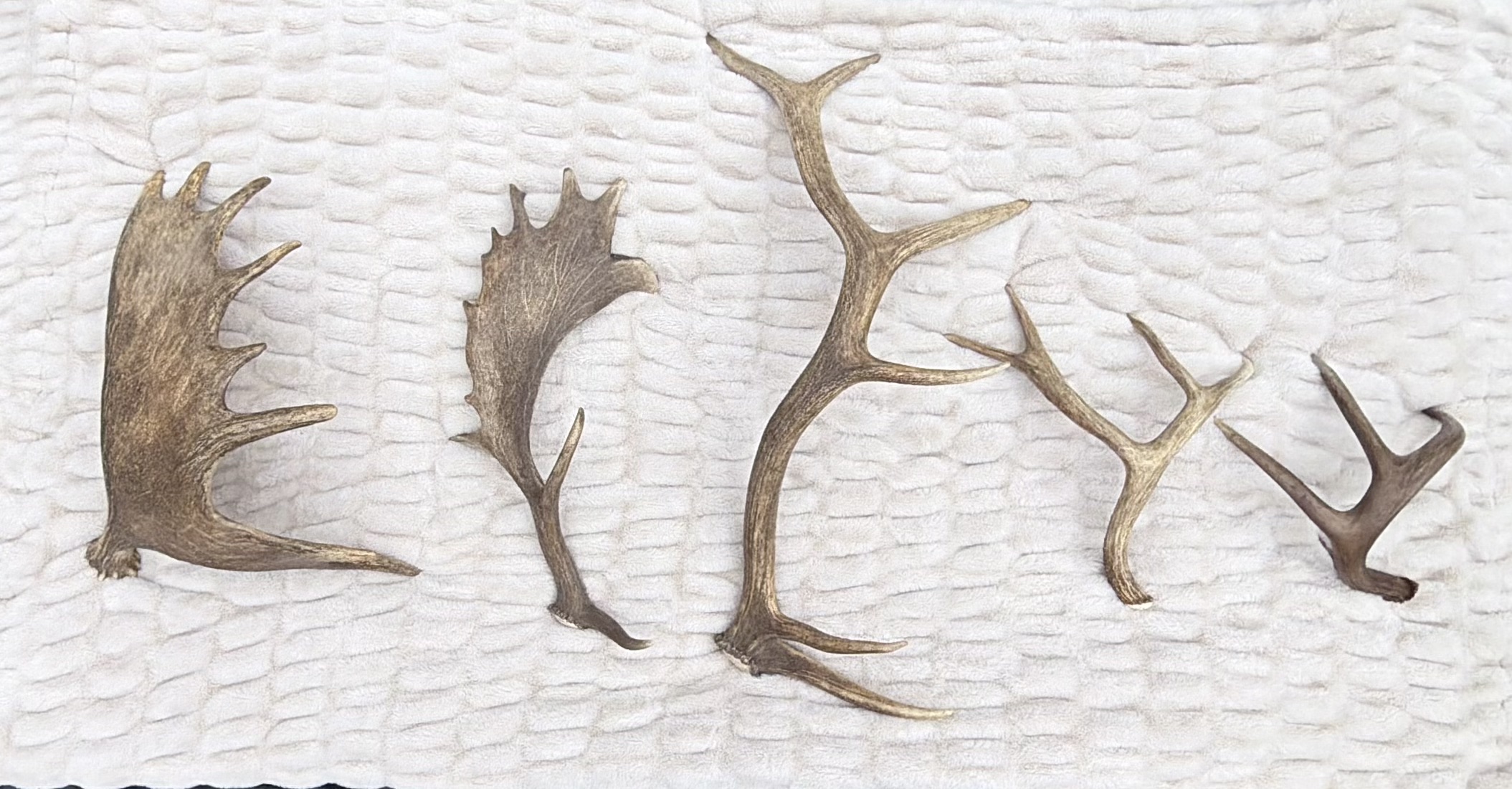
Antler Species at a Glance
| Species | Antler structure | Natural color | Scale it delivers | Chosen by | Our chandelier range |
|---|---|---|---|---|---|
| Elk Cervus canadensis | One long, sweeping main beam per side with five to six upswept tines | Golden tan through chocolate brown | Long, sweeping antlers suited to great rooms | Great rooms, vaulted ceilings, lodges, hospitality | $7,500 – $14,800 |
| Whitetail Odocoileus virginianus | A single forward-curving main beam with individual tines rising vertically from it | Light tan, often the palest of the four | Compact per antler; scale comes from stacking tiers | Cabins, farmhouses, traditional interiors, hunters east of the Rockies | $750 – $13,800 |
| Mule Deer Odocoileus hemionus | Bifurcated — the beam forks into a Y, and each fork forks again | Rich mid-brown, heavily textured | Wide and open. Broad footprint, moderate height | Dining rooms, western interiors, buyers from the Rockies and Southwest | $2,200 – $7,800 |
| Fallow Deer Dama dama | Palmate — the upper antler flattens into a broad shovel or blade | Warm woodsy brown, smooth-surfaced | Mid-scale, but visually solid rather than open | Designers, modern and transitional rooms, anyone wanting something unusual | $6,000 – $7,400 (pendant from $600) |
| Moose Alces alces | Palmate on a massive scale — broad paddles fringed with short points | Deep brown with pale fringes | The largest material available, and the heaviest | Northern-tier buyers, lodge halls, statement commissions | No standard chandelier — sconces and lamps from $1,400, chandeliers by custom quote |
The shortest version. Elk buys you scale. Whitetail buys you familiarity. Mule deer buys you width. Fallow buys you a shape nobody else on the street has. Moose buys you the largest object in the room.
Elk Antler: The Species You Choose for Size
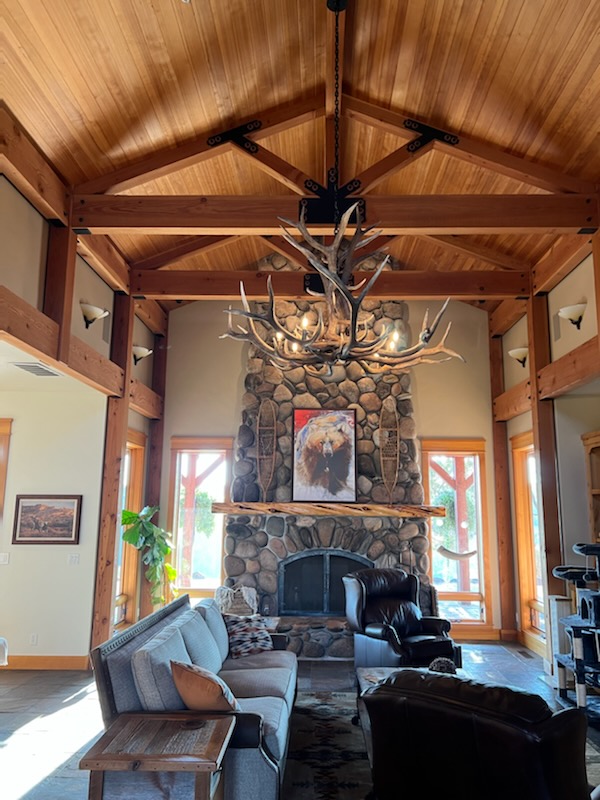
A mature bull elk carries a single long main beam on each side, with five or six tines sweeping up and back off it. Most mature bulls are six-point — a rack of twelve total points is called a royal. Those beams are the longest and heaviest material in regular use in antler lighting, which is why elk is the answer whenever the question is scale.
The visual character is sweep. Where deer antler reads as a cluster of upright points, elk reads as long curves moving outward from the center. That gives an elk fixture a horizontal reach that the deer species cannot match at the same light count, and it is the reason elk designs carry a 20-foot ceiling without looking stranded.
Who chooses elk. Buyers with a great room, a vaulted or cathedral ceiling, a two-story entry, or a lodge, restaurant or tasting-room ceiling. Also elk hunters and Rocky Mountain residents, for whom the species is the point. Elk is the most common request we get from designers specifying for mountain-region clients.
What to be aware of. Elk is heavy, and elk fixtures are the ones most likely to need a fixture-rated ceiling box mounted to a joist or to blocking. In a room under about 14 feet across, a full elk piece will dominate — see the size guide before committing.
In our collection: browse every elk antler chandelier we build, or start here — the Wilderness and Yellowstone are the entry points to full elk; Snowcrest shares Yellowstone's dimensions with a fuller center and more lights; and the Selway 2-Tier is the largest standard fixture we build. For elk character at a smaller scale, the Wapiti floor lamp and the Extra Large 6 Candle candelabra both use bull elk antler.
Whitetail Antler: The Classic Shape, and the Regional Favorite
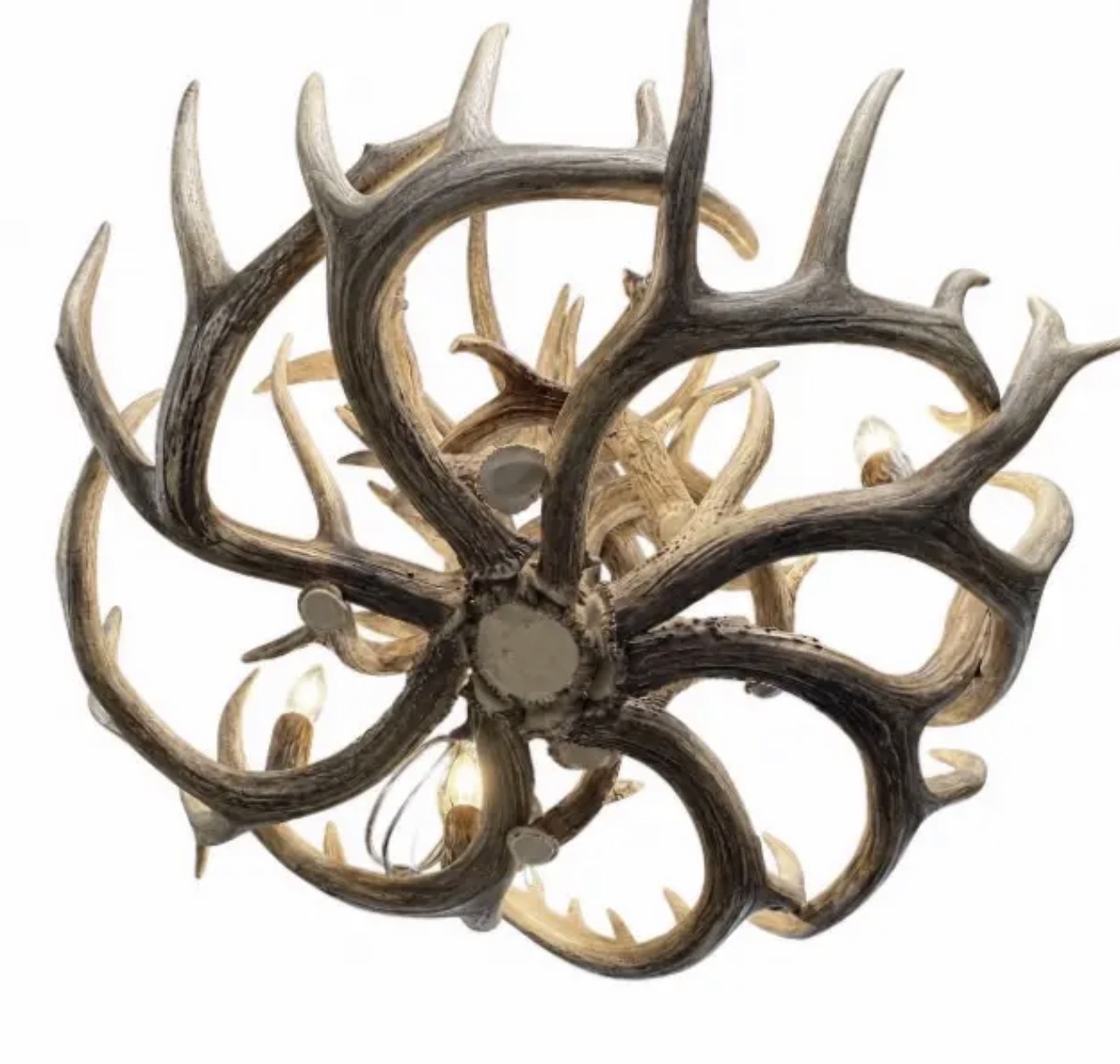
Whitetail antler is the silhouette most people picture when they hear "antler chandelier." Each antler is a single main beam that curves forward, with individual tines rising straight up off it — no forking. The result is a tighter, more vertical, more symmetrical profile than any other species, and the palest natural color of the four common deer.
Whitetail is also the species most Americans actually live alongside. White-tailed deer range across almost the entire country east of the Rockies and well into the South, the Midwest, the Northeast, Texas and southern Canada — far wider than any other North American deer. That matters more than it sounds.
If you live in whitetail country, start with whitetail. A large share of our customers choose their species on geography before anything else. A whitetail fixture in a Georgia farmhouse, a Pennsylvania hunting camp, a Texas ranch house or a Wisconsin lake place is not a generic rustic light — it is the deer outside the window. Buyers tell us this repeatedly, and it is usually the deciding factor when two designs are otherwise equal. The same logic sends western buyers to mule deer and mountain-state buyers to elk.
Who chooses whitetail. Cabin, farmhouse and lodge interiors; traditional and transitional rooms; hunters and their families anywhere in whitetail country; and anyone who wants the recognizable antler look rather than an unusual one. It is also where our most accessible pricing sits.
What to be aware of. An individual whitetail antler is small. Scale in whitetail comes from stacking — which is exactly what our tiered designs do, and a six-tier whitetail fixture will hold a room that a single-tier one would disappear in.
In our collection: see all our whitetail antler chandeliers, or start here — the Single Tier Fawn is our most compact chandelier and the easiest way into a real antler fixture; the Single Tier Whitetail and Two Tier Whitetail cover most dining rooms; the Roundup is a rectangular form built to track a long table; and the 6 Tier and XL 6 Tier are our large-format whitetail pieces for great rooms and vaulted ceilings. The Pathfinder and Kootenai wall sconces let you carry whitetail down a hallway or flank a fireplace.
Mule Deer Antler: Width and Open Branching
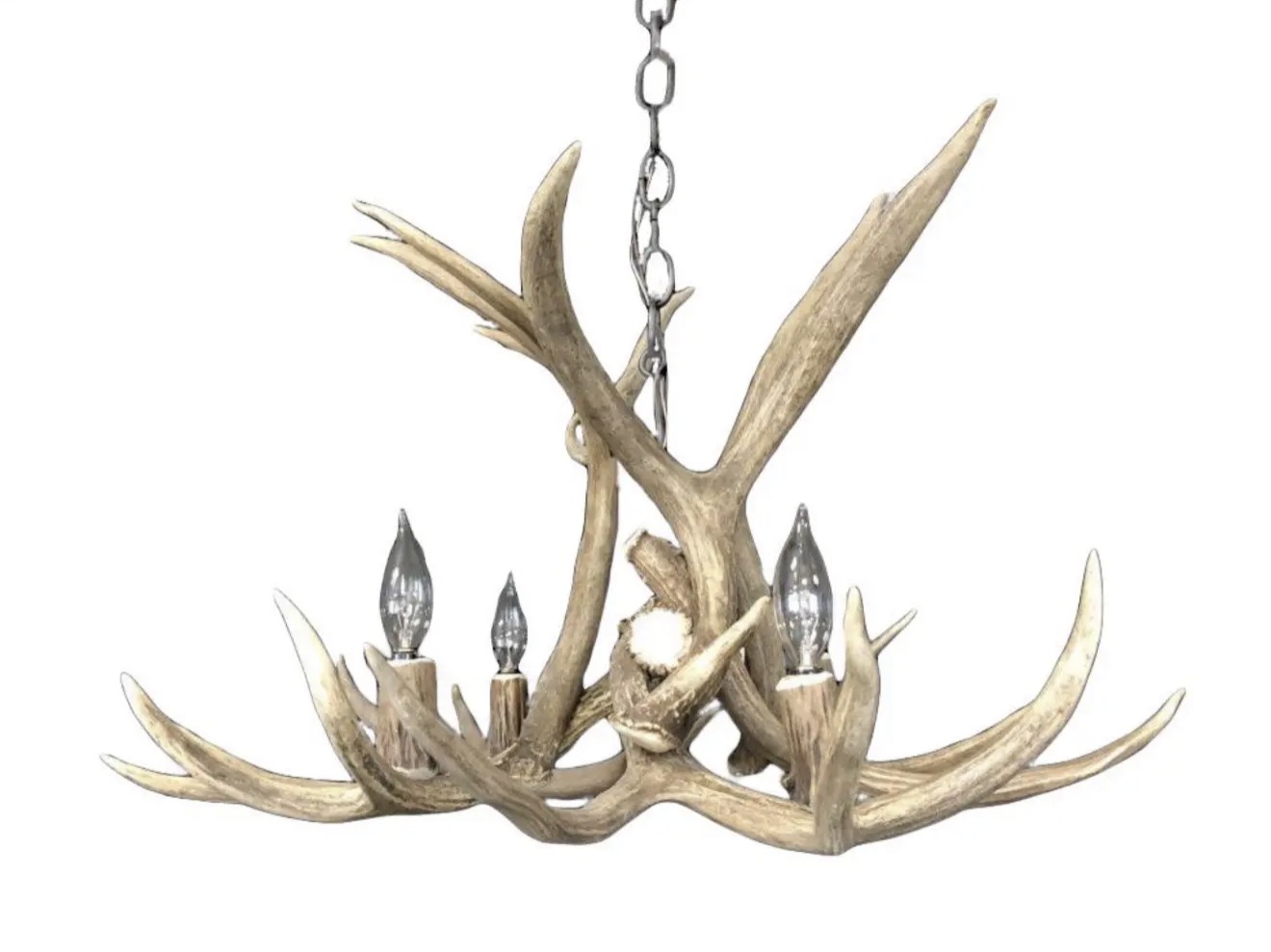
Mule deer antler branches differently from every other species here. Instead of tines growing off one beam, the beam itself forks into a Y, and each arm of that Y forks again. Biologists call it bifurcated branching. A mature buck is typically a four-point-per-side rack built from those repeating forks, with small brow tines or none at all.
Visually, that fork-and-fork-again structure creates an open, spreading, candelabra-like shape — wide and airy rather than dense. Mule deer antler is also noticeably darker and more heavily textured than whitetail, with deeper ridging and a richer brown. It is thick, sturdy material, which is why it takes well to tiered designs.
Who chooses mule deer. Western buyers, first of all — mule deer are a Rocky Mountain, Great Basin, Southwest and Pacific Northwest animal, and people from those states choose them the way whitetail country chooses whitetail. Beyond region: anyone furnishing a dining room who needs a fixture to read wide without hanging low, and anyone who wants more visual texture than whitetail gives.
What to be aware of. Mule deer spreads. Over a dining table, keep at least 12 inches of clearance each side of the table so nobody sits looking through tines.
In our collection: see every mule deer antler chandelier in the collection, or start here — the Osprey Single Tier is our most affordable mule deer chandelier; Shoshone and Deerlodge suit standard dining rooms; the Aspen 2-Tier adds vertical presence; and the Cascade 3-Tier is the full statement piece. The Madison lamp carries the same antler at table scale.
Fallow Deer Antler: Palmate and Sculptural
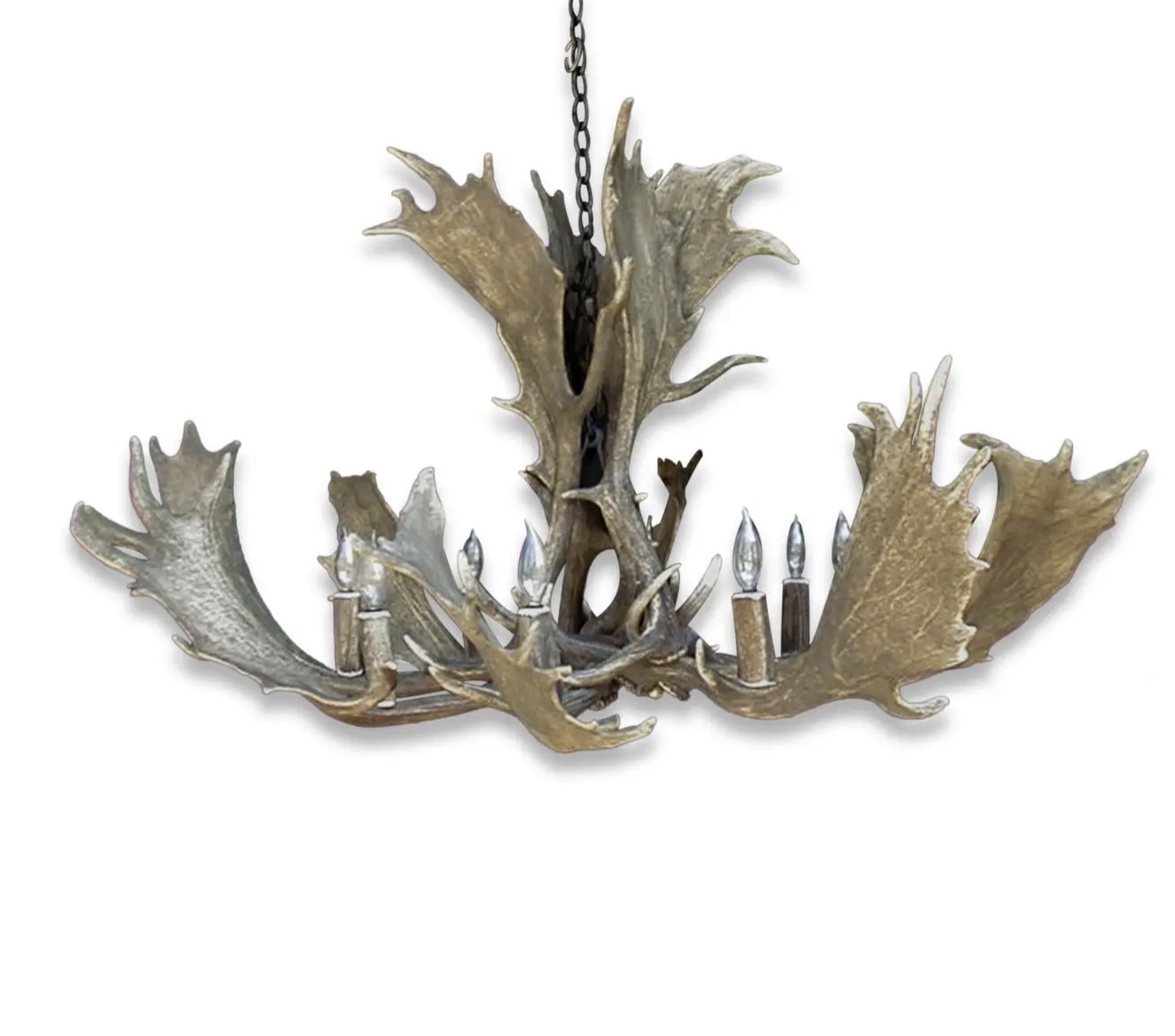
Fallow deer antler is the outlier, and for a lot of buyers that is the appeal. Rather than branching into points, the upper portion of a mature fallow antler flattens into a broad, smooth blade — palmate, from the resemblance to an open palm. Only two deer in the world grow palmate antlers: fallow and moose. Everything else is dendritic, meaning branched like a tree.
The design consequence is significant. A fallow fixture reads as planes and curves rather than a thicket of points. It catches light across a flat surface instead of scattering it through tines, the color is an even woodsy brown, and the overall effect is closer to sculpture than to trophy. It is the species we most often recommend to buyers who like the material but not the traditional lodge look.
Who chooses fallow. Interior designers and trade clients, more than any other species. Modern, transitional and coastal interiors where a heavily branched fixture would look out of place. Buyers who specifically do not want something that reads as hunting decor. And European clients, for whom fallow is the familiar park deer.
What to be aware of. Fallow deer are an Old World species — native to the eastern Mediterranean and now established across Europe, New Zealand and parts of Texas — so there is no North American regional association to draw on. In the trade it is classed as an exotic, alongside species such as axis, sika and red stag. Fallow is chosen on looks, not on hometown.
In our collection: browse the fallow deer antler chandeliers, or start here — the Heron pendant is a two-antler fixture for a kitchen island, nook or stairwell, and the lowest-priced hanging fixture we make; the Glacier Single Tier shows the broad palmation at full chandelier scale; and the 2 Tier Fallow Deer is our largest standard piece built around fallow, pairing sixteen fallow antlers with eight mule deer for added height and branching.
Moose Antler: When Nothing Else Is Big Enough
Moose antler is palmate like fallow, at roughly four times the scale. A mature bull grows two broad paddles fringed with short points, commonly spanning four to five feet across the pair, and the material is dense and genuinely heavy. There is no larger antler.
Who chooses moose. Northern-tier buyers — Alaska, Maine, Minnesota, Montana, Wyoming, northern New England and Canada — and anyone commissioning a fixture for a lodge hall, a hotel lobby or a room where the chandelier is meant to be the architecture rather than sit within it.
What to be aware of. Weight and ceiling structure are the real constraints, not price. Any large moose piece needs a rated box or blocking and, realistically, professional installation.
In our collection: the Denali wall sconce and Kenai lamp are our standard moose pieces. Moose chandeliers are built as custom commissions — tell us the room and we will quote it.
How Many Antlers Does a Chandelier Take?
Between 2 and 70, depending almost entirely on species. This is the part of the decision nobody explains, and it is the clearest way to understand what you are actually choosing between.
It starts with the antler itself. An elk antler is several times the weight of a whitetail antler, and a moose antler heavier still, which is why elk and moose fixtures are the heavy ones even though they use the fewest pieces. We don’t publish fixed weights — antler varies naturally in size and density, so no two fixtures of the same design come out identical — but we’ll give you an approximate weight before you order and an exact shipping weight once your piece is built.
A single elk antler covers far more space than a single whitetail antler, so an elk fixture reaches its diameter with a handful of pieces while a whitetail fixture of similar size needs dozens. Our Wilderness spans 40 to 50 inches using 8 elk antlers. Our 6 Tier Whitetail spans 36 to 40 inches — slightly narrower — using 70 whitetail antlers. Comparable size, nearly nine times the antler.
| Fixture | Species | Antlers used | Width |
|---|---|---|---|
| Single Tier Fawn | Whitetail | 3 | 20" |
| Heron pendant | Fallow | 2 | 12"–14" |
| Osprey Single Tier | Mule deer | 8 | 28"–34" |
| Wilderness | Elk | 8 | 40"–50" |
| Glacier Single Tier | Fallow | 12 | 42"–52" |
| Yellowstone | Elk | 12 | 60"–65" |
| Shoshone | Mule deer | 18 | 32"–36" |
| Two Tier Whitetail | Whitetail | 18 | 25"–29" |
| Selway 2-Tier | Elk | 18 | 65"–70" |
| Cascade 3-Tier | Mule deer | 26 | 36" |
| Aspen 2-Tier | Mule deer | 32 | 28"–36" |
| 6 Tier Whitetail | Whitetail | 70 | 36"–40" |
| XL 6 Tier Whitetail | Whitetail | 70 | 48"–56" |
What this actually tells you. Elk is the efficient species for reach — the Yellowstone gets to 60–65 inches on 12 antlers, while the XL 6 Tier Whitetail needs 70 antlers to reach 48–56 inches, and uses far more material doing it. Fallow is the quiet surprise: 12 palmate antlers carry the Glacier to 42–52 inches, because broad blades cover space that branched tines leave open. Whitetail’s smaller antlers require more individual pieces, fitting, and drilling to achieve a large silhouette.
Choosing by Where You Live
This is the shortcut a surprising number of our customers use, and it is a good one. Matching the species to your region turns a light fixture into something local.
| If you live in… | The local species is… | Start with |
|---|---|---|
| The Southeast, Mid-Atlantic, Northeast, Midwest and most of Texas | Whitetail | Two Tier Whitetail, XL 6 Tier |
| The Rockies, Great Basin, Southwest and interior Pacific Northwest | Mule deer | Deerlodge, Cascade 3-Tier |
| Montana, Wyoming, Colorado, Idaho, Utah, New Mexico, Oregon, Washington — plus reintroduced herds in states such as Kentucky, Pennsylvania and Arkansas | Elk | Wilderness, Yellowstone |
| Alaska, Maine, Minnesota, northern New England and Canada | Moose | Denali sconce, or a custom build |
| Anywhere the local species isn't the look you want | Fallow | Glacier, Heron pendant |
Two places where both apply: much of Montana, Wyoming, Colorado and the Dakotas hold whitetail and mule deer, and parts of Texas hold whitetail alongside introduced fallow and axis. In those states a mixed-species fixture is often the honest answer — see when to mix species below.
Choosing by the Scale Your Room Needs
If geography does not settle it, scale usually will. Species and size are not independent choices: some species simply cannot deliver certain dimensions without going to multiple tiers.
| Room | Species that work | Why |
|---|---|---|
| Nook, island, small bedroom, stairwell landing | Fallow pendant, small whitetail | Two-antler pendants and compact single-tier fixtures suit these smaller spaces |
| Standard dining room, 9–10 ft ceilings | Whitetail, mule deer, fallow | All three hit 25–36 in wide at a sensible height |
| Large dining room or living room, 10–12 ft ceilings | Mule deer tiers, whitetail tiers, elk & mule deer mixes | Vertical room for two and three tiers |
| Great room, vaulted or cathedral ceiling | Elk, elk & mule deer, XL whitetail tiers | Only elk beams and six-tier stacks read correctly against that volume |
| Lodge hall, hotel lobby, restaurant | Elk, moose, custom | Above about 70 in, everything is a custom build |
Work out your target dimensions first in the antler chandelier size guide, then come back here to pick the species that delivers them.
Choosing by Interior Style
- Traditional lodge, cabin, hunting camp. Whitetail or elk, natural color, and the more tines the better.
- Mountain modern. Elk for the long lines, or fallow for flat planes. Avoid the densest multi-tier designs — they fight clean architecture.
- Farmhouse and transitional. Whitetail in natural tan. It reads warm rather than dramatic.
- Western and ranch. Mule deer. The forked structure and darker color are the western look.
- Contemporary, coastal, minimal. Fallow, or bleached white antler in any species. White antler against a pale wall reads as sculpture and stops reading as taxidermy entirely.
- Hospitality. Elk or moose at scale, usually custom, and usually specified by a designer. Get in touch about trade and hospitality projects.
Beyond Species: The Other Antler Choices That Change the Look
Species is the biggest decision, but four more choices change the finished fixture as much as the animal does.
Natural or bleached white
Every species is offered in its natural color or bleached white. Natural keeps the tan-to-brown gradient, the weathering marks and the darker burrs at the base — warmer, more organic, more traditional. White strips the color variation out and leaves form, which is why it suits contemporary and coastal rooms. White is a flat upcharge on any fixture, not a per-light one.
Where the antler comes from
The antler we source is naturally shed. Bucks and bulls drop their antlers every winter and spring and grow a new set — whitetail typically in January and February, mule deer a month later, elk in spring, fallow in April and May — and shed antler is collected off the ground. We sort every shipment by species, size, color and curve before anything goes into a build, and only the top grade is used. Separately, customers regularly send us antler from their own collections for a custom build; in that case the material is whatever they provide. See Use Your Antlers for how that works.
Real antler or resin
Every fixture we build uses real antler. The only molded component anywhere in our collection is the antler socket cover at each light, and real antler socket covers are available as a paid upgrade at $45 per cover. A great deal of what is sold online as an "antler chandelier" is cast resin throughout — our real vs. faux guide covers the seven-second test for telling them apart.
"Deer horn" versus deer antler
You will see "deer horn chandelier" used online, and it means the same thing as a whitetail or mule deer antler chandelier. Strictly, deer do not grow horns. Horn is a permanent keratin sheath over a bony core, found on sheep, cattle, bison and antelope, and it is never shed. Antler is solid bone, grown and dropped annually. Every fixture on this site is antler.
When to Mix Species
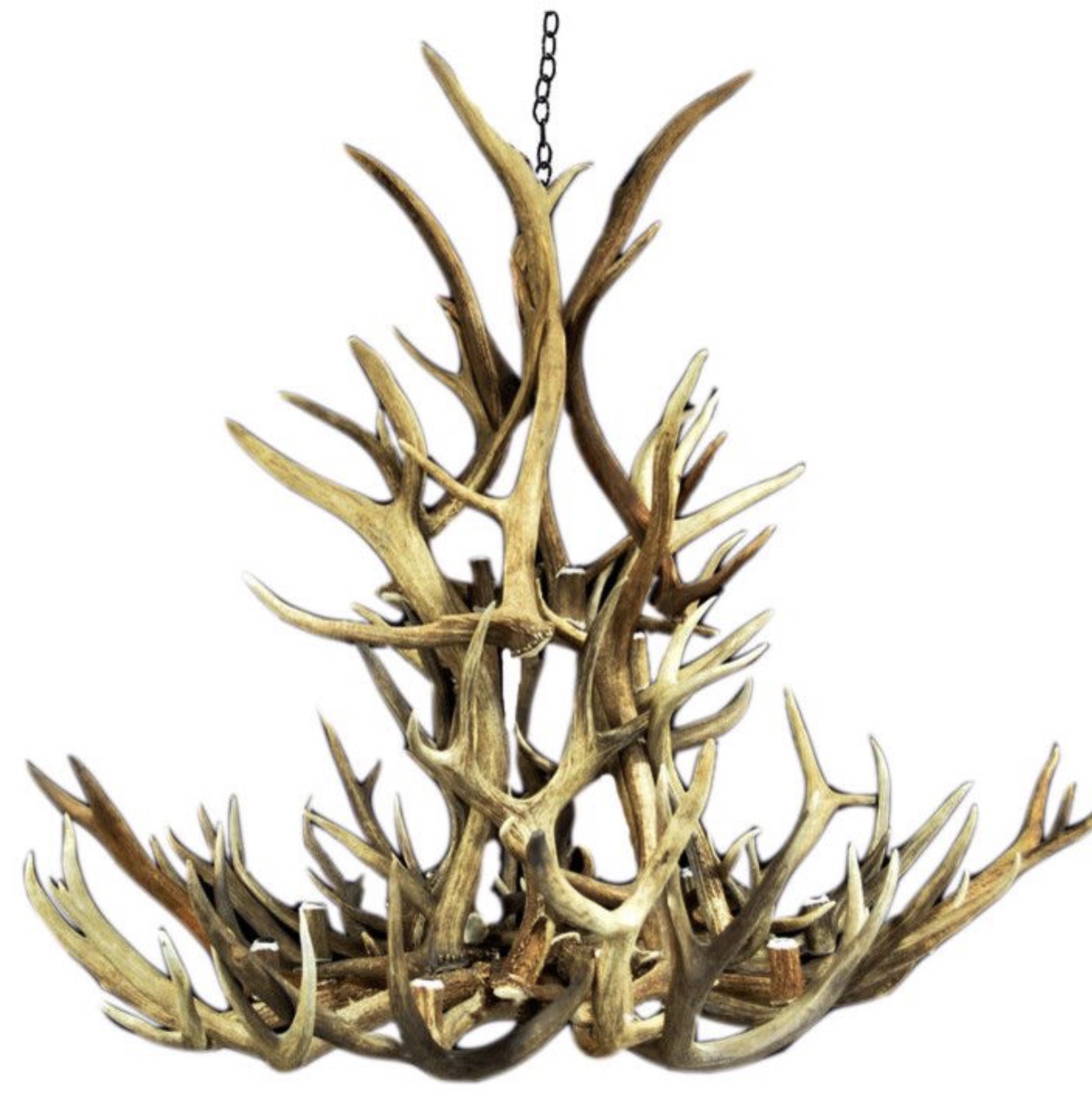
Mixing is not a compromise — several of our strongest designs are built on it deliberately. Elk supplies the long outer beams that set the diameter, and mule deer or whitetail fills the interior so the fixture has density as well as reach. You get elk scale without elk-only mass, usually at a lower price than an all-elk piece of the same span.
Mixed designs also solve the two-species problem honestly for buyers in states that hold both. Big Sky, Gallatin and Salish pair elk with mule deer; Renegade pairs mule deer with whitetail; and the Teton sconce combines elk and whitetail. Any species combination can be built to order.
What Actually Drives the Price
Species matters less to cost than people expect. The bigger drivers are how much antler a design consumes, how many lights it carries, and the fitting work it requires. An elk fixture costs more than a whitetail one mostly because it is larger, not because elk antler is inherently precious.
In our collection, whitetail spans the widest price range of any species — from our most compact fixture to our largest six-tier piece — because tiered whitetail designs use a great deal of material. Mule deer sits in the middle. Fallow is limited by availability rather than by scale. Elk occupies the top of the range because elk designs are the biggest things we build.
Current starting prices are shown on every product page; select your options there for an exact figure. Every chandelier, pendant and sconce we build is UL Listed under file E238337 for the United States and Canada, including all standard designs, custom builds and pieces made from your own antlers. Our table and floor lamps are not covered by that listing.
Still deciding between species? Ask Dante directly.
Dante Martin has been building antler lighting for over twenty years and has handled more elk, mule deer, whitetail and fallow antler than almost anyone working in it. Send your room dimensions, ceiling height, a photograph of the space, and a note on what you are drawn to — he will tell you which species will actually work and which one he would choose. There is no cost and no obligation.
Frequently Asked Questions
What types of antlers are used in antler chandeliers?
Five species account for almost all real antler lighting: elk, whitetail deer, mule deer, fallow deer and moose. Elk gives the most size, whitetail the most familiar shape, mule deer the widest spread, fallow a flat palmate look, and moose the largest material available.
Which antler species is best for a large room?
Elk. A mature bull elk antler has the longest main beam of any species in common use, so an elk chandelier reaches further across a room at the same light count. For great rooms and vaulted ceilings, elk or an elk and mule deer combination will hold the space when a deer-only fixture would look undersized. An extra-large six-tier whitetail design is the main alternative.
Elk or whitetail — which should I choose?
Choose elk if the room is large, the ceiling is high, or you want one fixture to be the focal point: elk has the longest main beam of any species we build with, so it reaches further and reads correctly against a big volume. Choose whitetail if you want the classic antler silhouette, if whitetail is the deer where you live, or if you are working with a standard-height dining room. The two also differ in color — whitetail is the paler, warmer tan and elk runs golden through chocolate — and in structure, since whitetail tines rise vertically off a single beam while elk sweeps outward in long curves.
What is the difference between mule deer and fallow deer antler?
They are opposites in structure. Mule deer antler is bifurcated and open — the beam forks into a Y and each fork forks again, giving a wide, branching, heavily textured rack in a darker brown. Fallow deer antler is palmate and closed — the upper antler flattens into a broad, smooth blade, giving flat planes rather than points, in an even woodsy brown. Mule deer suits western and ranch interiors; fallow suits modern, transitional and coastal rooms where a branched fixture would look out of place.
What is the difference between whitetail and mule deer antlers?
Whitetail antlers have one main beam per side with single tines rising vertically off it, producing a compact, symmetrical, basket-like shape in a pale tan. Mule deer antlers are bifurcated: the beam forks into a Y and each fork forks again, producing a wider, more open, darker and more heavily textured rack.
Should I choose the antler species that lives where I live?
Many of our customers do, and it is a sound way to decide. A whitetail fixture in whitetail country, or mule deer in the Rockies, connects the piece to the landscape outside instead of reading as generic rustic decor. If the local species is not the look you want, fallow deer has no North American association and is chosen purely on appearance.
What is palmate antler?
Palmate antler is antler that flattens into a broad, blade-like plane instead of branching into separate points. Only fallow deer and moose grow palmate antlers; every other deer species grows dendritic, tree-branched antler. Palmate antler gives a fixture flat surfaces and a more sculptural, less traditional look.
Are antler chandeliers made from real antlers?
Ours are. The antler we source is naturally shed — deer, elk and moose drop their antlers each year and grow a new set — and we build only from real antler, never cast or molded reproductions. The one molded component is the socket cover at each light, and real antler socket covers are available as an upgrade at $45 per cover. Customers also send us antler from their own collections for custom builds.
How many antlers does an antler chandelier take?
Between 2 and 70, depending on species and size. A single elk antler covers far more space than a whitetail antler, so elk fixtures use few pieces — our 8-light Wilderness spans 40 to 50 inches on 8 elk antlers — while whitetail fixtures of similar size need dozens, with our 6 Tier Whitetail using 70. Mule deer sits between the two, at 8 antlers for a small single-tier fixture and 26 to 32 for a multi-tier design. Our smallest pieces include the 3-light Fawn, which uses 3 antlers, and the Heron pendant, which uses 2.
How much does an antler chandelier weigh?
It depends on species and size, and we don’t publish fixed weights, because antler varies naturally in size and density and no two fixtures of the same design weigh exactly the same. As a guide, elk and large multi-tier whitetail pieces are the heaviest we build, mule deer and single-tier designs the lightest. Any chandelier over 50 pounds must be mounted to a fixture-rated ceiling box secured to a joist, or to blocking between joists, so ask us for the figure on your specific piece if you need it for structural planning — we’ll give you an approximate weight before you order and an exact shipping weight once it’s finished.
Which antler species is the most affordable?
Entry pricing is lowest in whitetail and fallow, because our smallest fixtures are built in those species — a compact single-tier whitetail chandelier and a two-antler fallow pendant. Mule deer starts higher, and elk higher still, mostly because elk designs are the largest pieces we build.
Can you mix antler species in one chandelier?
Yes, and several of our designs do it deliberately. Elk supplies the long outer beams that set the diameter while mule deer or whitetail fills the interior, giving elk-scale reach with more density and usually a lower price than an all-elk fixture of the same span. Any combination can be built to order.
What color are antler chandeliers?
Natural antler ranges from pale tan through golden brown to deep chocolate, depending on species and how long the antler weathered before it was collected. Whitetail is generally the palest and mule deer the darkest. Every fixture is also offered bleached white, which removes the color variation and leaves the form — a better fit for contemporary and coastal interiors.
Is a deer horn chandelier the same as a deer antler chandelier?
Yes. "Deer horn chandelier" is a common search term for the same product, but deer do not grow horns. Horn is a permanent keratin sheath, found on sheep, cattle and antelope. Antler is solid bone that is grown and shed every year, and every fixture we build is antler.
How do I know which species is right for my room?
Work out the diameter and fixture height your room needs first, then choose the species that delivers those dimensions in the style you want. If you would rather not do it on paper, send Dante your room dimensions, ceiling height and a photograph and he will recommend a species and a specific design.
Are all antler species covered by your UL listing?
Species does not affect certification. Every chandelier, pendant and wall sconce we build is UL Listed under file E238337 for the United States and Canada, in any species, including all standard designs, custom builds and pieces made from your own antlers. Our table and floor lamps are not covered by that listing.
Choose Your Species With Help
Go straight to a species: elk antler chandeliers, whitetail antler chandeliers, mule deer antler chandeliers, or fallow deer antler chandeliers. Or browse the full real antler chandelier collection and the shop. If you want a species or configuration we do not currently stock, we design custom antler chandeliers to your room, and we can build with antlers you already own.
Estimated build time is 6–10 weeks from order confirmation. Shipping time is additional. For custom designs, we will confirm your timeline with your quote.
Contact us or call (702) 861-8116 and ask for Dante.

