


Are Antler Chandeliers UL Listed? UL Listing vs. UL Components
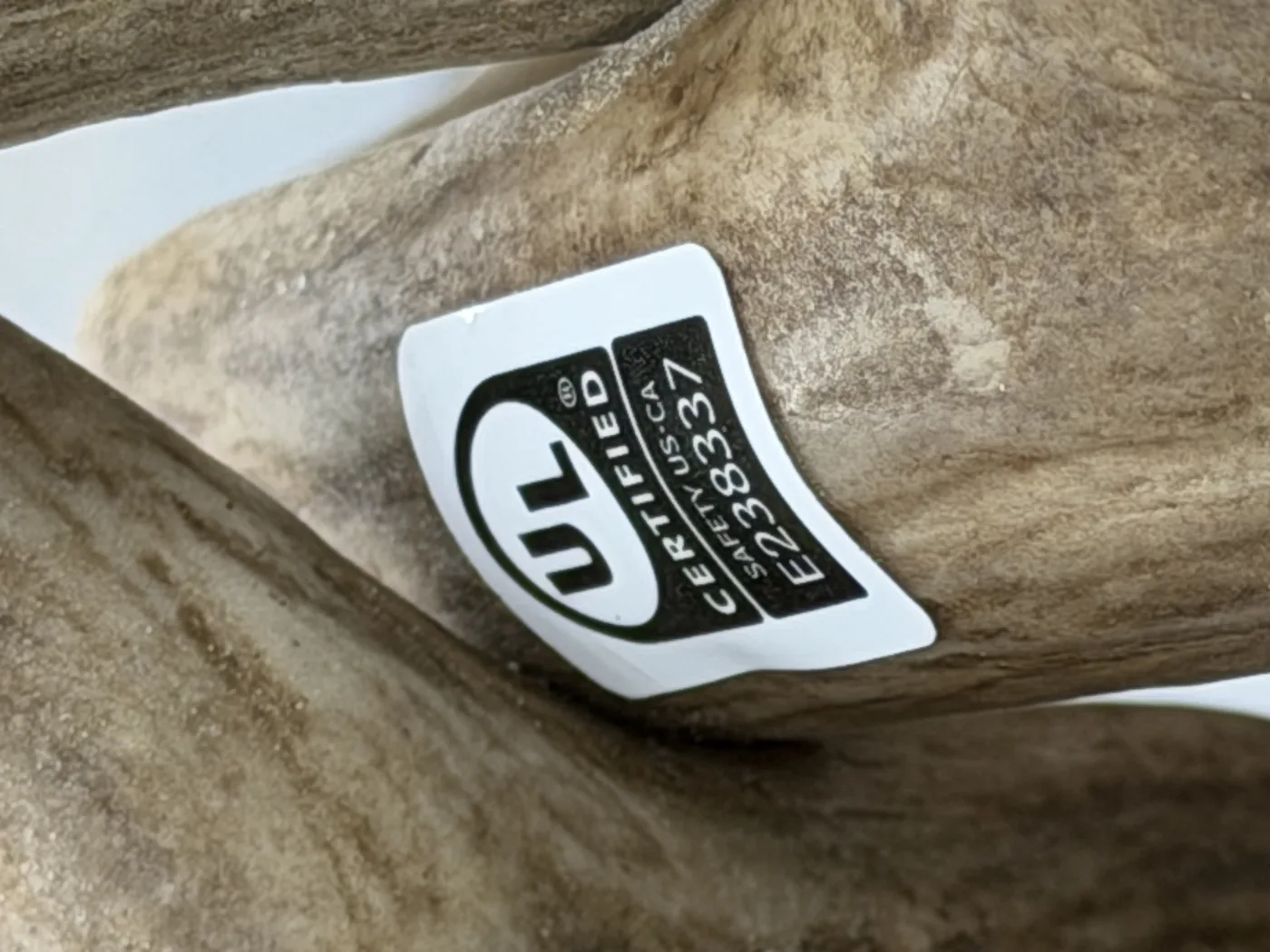
Some antler chandeliers are UL Listed. Most are not. The distinction that matters is not whether a fixture contains certified parts, but whether the finished fixture itself was tested and listed. Every chandelier, pendant and sconce we build — including custom commissions and builds using a client’s own antlers — is UL Listed under file E238337.
That distinction — a certified fixture versus a fixture assembled from certified parts — is the single most important thing to understand before spending four or five figures on handmade lighting. Below is what the certification covers, where it is legally required, why designers and resellers screen for it, and the six questions to ask any maker.
Key points
- “UL Listed” means the assembled fixture passed testing. “Made with UL listed components” means it did not.
- UL is one of several OSHA-recognized testing laboratories (NRTLs). ETL/Intertek and CSA marks count equally; no mark at all is the problem.
- NEC 410.6 requires luminaires to be listed. The adopted code edition and enforcement vary by jurisdiction, and commercial projects may also be subject to OSHA workplace requirements.
- An unlisted fixture may be rejected or red-tagged by the authority having jurisdiction and may require a field evaluation before it can be approved for use.
- Our listing covers every chandelier, pendant and sconce we build — including custom commissions and builds using a client’s own antlers, not just catalogue models.
What does “UL Listed” mean for a light fixture?
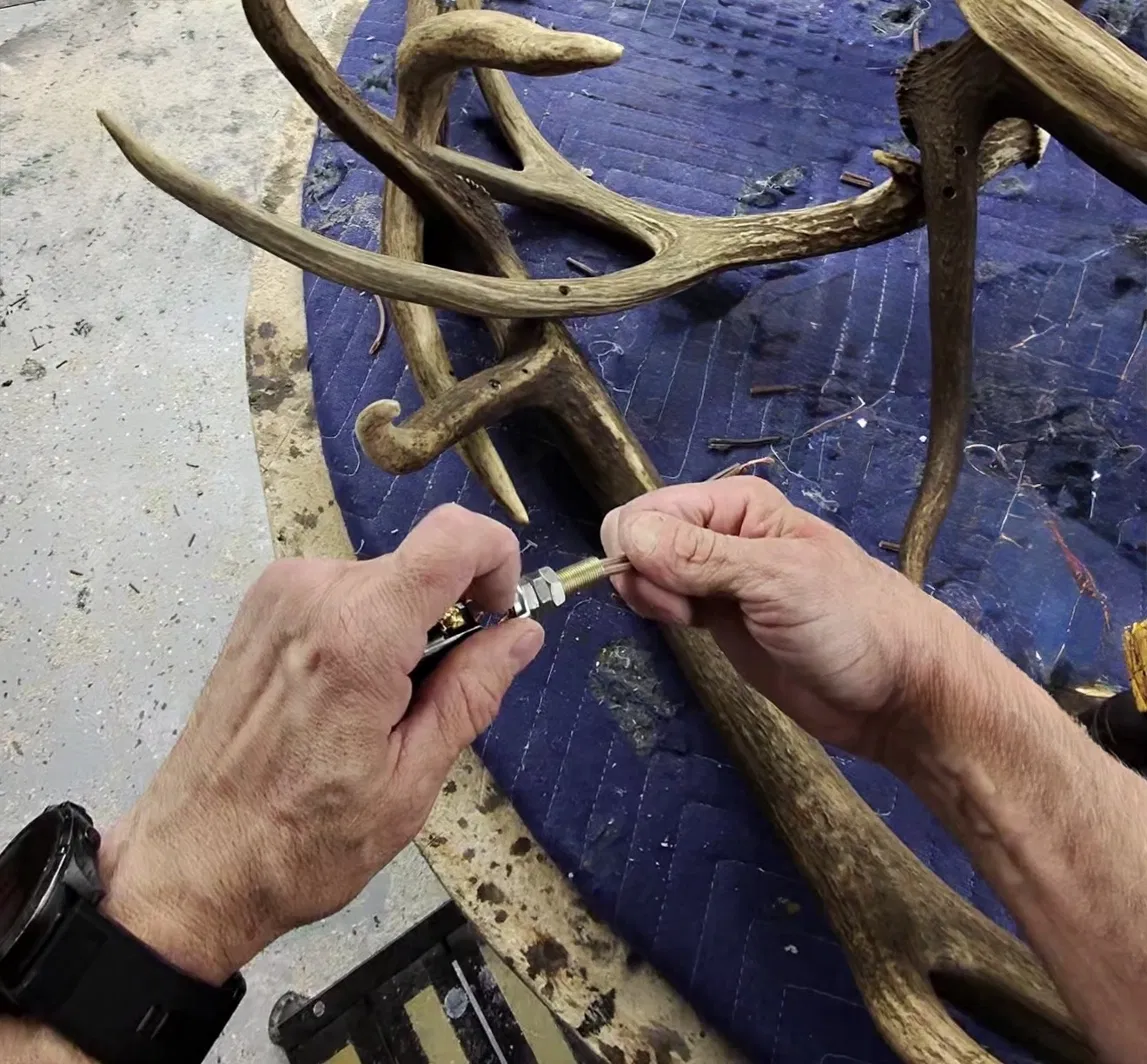
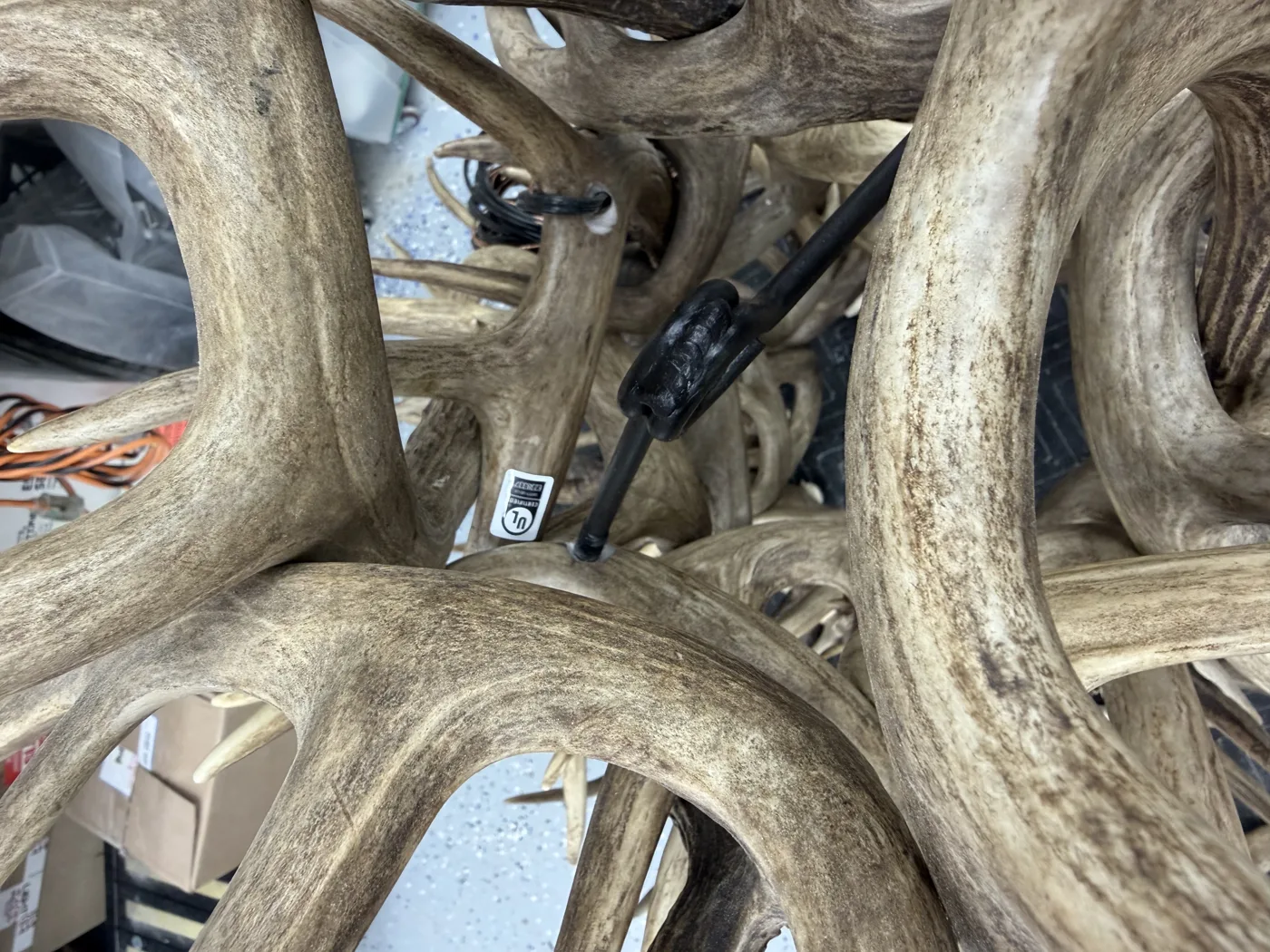
UL Listed means an independent laboratory tested the complete, assembled fixture against a published safety standard, the manufacturer holds a searchable file number for it, and production remains under periodic follow-up inspection. It certifies the finished product — not the parts inside it.
Underwriters Laboratories is an independent safety-certification body. When a finished fixture carries a UL listing, three things are true:
- The complete fixture — not just its parts — was tested against the published safety standard for that type of luminaire.
- The manufacturer holds a file number. Ours is E238337, and files are searchable in UL’s public Product iQ database, so the claim is verifiable by you, your electrician, your inspector or your insurer.
- Production stays under periodic follow-up inspection. It is not a one-time test a maker passes once and cites forever.
What is the difference between “UL Listed” and “made with UL listed components”?
A UL Listed fixture was tested as a finished assembly. “Made with UL listed components” means only the sockets and wire carry certification, while the chandelier they were built into was never submitted or tested. It is the most common phrasing in handmade lighting, and it is not equivalent.
Three phrases get used as though they mean the same thing. They do not:
“UL Listed”
The finished fixture is certified. This is the one that counts, and it comes with a file number.
“Made with UL listed components”
The sockets and wire each carry their own certification, but the assembled fixture was never submitted. There is no file number to look up, because there is no file.
“UL Recognized”
A component-level certification, intended for parts that go inside someone else’s certified product. It does not certify a finished fixture.
| “UL Listed” fixture | “Made with UL listed components” | |
|---|---|---|
| What was tested | The complete, assembled fixture | Individual parts, by their own makers |
| Who tested it | An independent certification body | The part suppliers — not the fixture builder |
| Covers the wiring as built? | Yes | No |
| Verifiable file number | Yes | No — there is nothing to look up |
| Ongoing factory inspection | Yes | No |
| Accepted for permitted work | Yes | Usually not |
Why the difference is not a technicality
Certified parts are a starting point, not a result. In a light fixture, the parts are rarely what fails — the assembly is. Wiring pulled through a sharp passage and abraded over time, strain relief that lets a socket pull loose, a ground connection that was never bonded to every metal part, a socket that shifts under the weight of the shade, heat pooling where the design does not let it escape. None of that is governed by the certification printed on the socket. All of it is exactly what listing a finished fixture tests for.
A useful comparison: every ingredient in a kitchen can be individually inspected and approved, and the meal can still make you ill. The certification has to cover the thing you are actually taking home.
Does it have to be UL, or do other certifications count?
It does not have to be UL specifically. UL is one of several Nationally Recognized Testing Laboratories (NRTLs) recognized by OSHA; marks from Intertek (ETL) and CSA Group carry equal weight with inspectors. Electrical code language says “listed,” not “UL.” The real risk is a fixture with no certification at all.
If a maker tells you their fixtures are ETL Listed or CSA certified, that is a legitimate answer and you should treat it as equivalent. What matters is that an accredited third party tested the finished product and that a file or control number exists to prove it. We use UL; another reputable maker may use Intertek. A maker who has neither, and offers “UL components” instead, is answering a different question than the one you asked.
Why are so few antler chandeliers certified?
Because certification is built around repeatable manufacturing, and antler is never repeatable. Certifying an antler fixture means certifying a construction method that holds up across natural variation in shape, density and length — a substantially higher bar than certifying one identical factory design, and one many handmade makers never attempt.
A factory chandelier is one design repeated ten thousand times. Test a single unit and every other unit is identical.
Antler does not work that way. No two racks share a shape, a density or a length. A certified antler fixture therefore has to be certified as a method: how wiring is routed and protected through irregular material, how strain relief is anchored, how sockets are secured so they cannot shift, how every metal part is grounded, how heat clears the material around each bulb. Listing is voluntary, it costs real money and years of accumulated process, and a handmade fixture can legally be sold without it. That is why so many are.
Is listed lighting required for commercial installations?
Listed luminaires are commonly required for permitted commercial installations. The National Electrical Code requires luminaires to be listed, but the code edition adopted and the way it is enforced vary by jurisdiction. The local authority having jurisdiction has final approval, so commercial buyers should confirm requirements with their electrician or inspector.
Two separate bodies of rules apply to a commercial job, and a fixture has to satisfy both.
Electrical code: NEC 410.6
The National Electrical Code states that all luminaires, lampholders and retrofit kits shall be listed. It is worth being precise about what that means: the requirement is not written for commercial buildings only — it applies to dwellings too. The practical difference is enforcement. Commercial work is permitted, inspected and signed off by an official who is reading that section; a lot of residential fixture-swapping never comes in front of anyone. The adopted code edition varies by state and municipality, and the authority having jurisdiction has the final say, so your electrician or inspector is the one to confirm with.
Workplace safety: OSHA
OSHA’s construction and general-industry standards require covered electrical equipment used in workplaces to be approved. One principal route to approval is certification, listing or labeling by an OSHA-recognized Nationally Recognized Testing Laboratory (NRTL). For commercial and hospitality environments where employees work, OSHA requirements may therefore apply in addition to local electrical-code requirements.
What actually goes wrong on a project
Custom and one-of-a-kind decorative lighting is a known friction point on hospitality and commercial jobs — inspectors regularly encounter artistic fixtures in hotels, casinos and restaurants that carry no NRTL certification. When that happens, the authority having jurisdiction may reject or red-tag the fixture and require the issue to be resolved before approval or use.
There is an escape hatch, and it is expensive. A field evaluation brings a certification body to the site to evaluate the installed equipment and apply a field label. It is a real and accepted path, but it costs money per fixture, has to be scheduled, and lands at the very end of a project when the client is waiting on a certificate of occupancy. Specifying a listed fixture at the start avoids the entire problem.
If you are buying for a commercial space, choose a fixture covered by our UL listing, and ask any other maker for a file number before the order goes in.
Why do designers, specifiers and resellers prefer a UL listed builder?
Because certification can help satisfy project specifications, reduce the risk of an inspection-related delay, and give the project team verifiable documentation about the fixture and its manufacturer.
Designers and dealers are rarely asking about certification out of caution alone. Each of these is a live professional risk:
- Specification compliance. Many architectural and hospitality specs require a listed fixture by name. A beautiful uncertified piece cannot be substituted in, no matter how well it suits the room.
- Schedule risk. An inspection failure surfaces at the end of a project, when the fixture is already hung and the client is already waiting. Listing removes that from the critical path.
- Professional documentation. A listed fixture gives designers and specifiers third-party certification information they can include in project records and submittals.
- Project documentation. General contractors, owners, insurers or other project stakeholders may request certification information. A file number provides documentation that can be independently checked.
- Reseller confidence. Dealers and galleries can document that the finished electrical fixture carries third-party certification rather than relying only on component-level claims.
- Documentation the client keeps. A file number, published specifications and a stated bulb rating go into the closeout package, the appraisal and the resale file. It follows the fixture.
- Repeatability. On a property that needs matched fixtures across a lobby, dining room and suites, the listing covers the method — so a set built to the same standard is consistent, and so is the paperwork.
Custom work is covered too
This is the point most worth knowing if you specify. Our listing under file E238337 covers every chandelier, pendant and sconce we build — not a fixed list of catalogue models. A one-off piece sized for a particular stairwell or great room carries the same certification as a fixture off the shop page. So does a build using antlers the client sends us from their own property, which is the case most makers cannot certify at all.
That is unusual, and it is the question to put to any maker offering custom work. A listing that stops at the catalogue edge means the bespoke piece you actually want is the one that arrives uncertified — and that is precisely the fixture most likely to be scrutinised at inspection.
Does UL listing matter for a home?
It can. The NEC listing requirement applies to luminaires in dwellings as well as commercial spaces, although the adopted code edition and enforcement vary by jurisdiction. For permitted residential work, buyers should confirm local requirements with their electrician or inspector and keep the fixture’s certification documentation.
The commercial case is the loud one, but the residential case is stronger than it looks:
- The code applies to your house too. NEC 410.6 does not carve out dwellings. If you are building, renovating or adding a circuit under a permit, an inspector may well look.
- Installation approval. An electrician or inspector may ask for evidence that a fixture is listed, particularly on permitted work. Confirming that before installation can prevent delays.
- Documentation. For a permanently installed electrical fixture, keeping certification information provides useful documentation for the homeowner, electrician and future property records.
- Future records. Keeping the certification file number and fixture specifications with a made-to-order piece gives future owners, electricians or inspectors useful information about what was installed.
- The physical reality. This is a heavy object, full of wiring, hardwired to your ceiling, running for hours at a time, generating heat inside organic material, hung above a dining table or a bed. It is the one decorative purchase in the house where the electrical system is doing real work every evening.
- Recourse. A listed fixture comes from a maker with a tested method, a file number and an inspection history. If something goes wrong, there is something to point at.
None of which means a home buyer needs to be alarmed — it means the question is worth one sentence in an email before ordering. A maker who holds a listing will answer it instantly.
Which of our fixtures are UL Listed?
Every chandelier, pendant and sconce we build, including custom work, is UL Listed under file E238337. Our table and floor lamps are wired but are not UL Listed or otherwise certified, and we say so plainly. Our candelabras, antler mirror and centerpiece are not wired at all, so no electrical certification applies to them.
| Product type | Count | Certification status |
|---|---|---|
| Chandeliers | 22 | UL Listed under file E238337 |
| Pendant (Heron Fallow Deer) | 1 | UL Listed under file E238337 |
| Sconces | 4 | UL Listed under file E238337 |
| Table and floor lamps | 4 | Wired, but not UL Listed or certified |
| Candelabras, antler mirror, centerpiece | 6 | Not wired — no electrical certification applies |
We state the lamp position plainly so the certification on our chandeliers, pendant and sconces is not read as applying to every product we sell. Our candelabras hold candles rather than bulbs, and the antler mirror and centerpiece carry no electrical parts at all, so there is nothing in them for a listing to cover. For permitted or commercial installations, confirm the requirements for the specific product with your electrician or inspector.
What should I ask before buying an antler chandelier?
Ask whether the finished fixture is listed or only built from listed components, what the file number is, whether the listing covers that specific product, whether it is hardwired or plug-in, what the bulb rating is per socket, and whether the antler and socket covers are real or resin.
- Is the finished fixture UL or NRTL Listed, or is it built from listed components? Ask for the distinction explicitly.
- What is your file number? A maker who holds one can produce it immediately.
- Does the listing cover this specific product, or only part of your range?
- Is the fixture hardwired or plug-in, and which does my installation require?
- What bulb type and maximum wattage per socket is it rated for?
- Is the antler real, and are the socket covers real antler or resin? A separate question from safety, but the same principle: ask, and get it in writing. Our guide to telling real antler from resin covers how to check.
Any maker who answers those six clearly is worth buying from. A maker who gets vague on the first two has told you something.
What specifications come with our listed fixtures?
- Certification: UL Listed under file E238337, verifiable in UL’s public database.
- Bulb base: E12 candelabra base across every listed fixture.
- Bulb rating: a maximum wattage per socket is published on every product page, with the total maximum for multi-socket fixtures.
- Light colour: 2700K warm white or 3000K, your choice at order.
- Chain length: 6, 10 or 20 feet.
- Lead time: each fixture is made to order, currently 8 to 10 weeks.
Sizing a fixture to the room is a separate question from certifying it — our antler chandelier size guide works through room dimensions, ceiling heights and hang heights, or you can browse the full collection to see what is currently available.
Frequently asked questions
Are all antler chandeliers UL listed?
No, and most are not. Listing is voluntary, it costs the maker real money and time, and a handmade fixture can be sold without it. Assume a fixture is not listed unless the seller states a file number you can verify.
Is ETL the same as UL?
For code purposes, effectively yes. ETL (Intertek) and CSA Group are, like UL, Nationally Recognized Testing Laboratories. Electrical code requires equipment to be “listed,” not to carry one particular brand’s mark.
Does it matter whether the antler is real or resin?
Not for certification — listing covers the electrical system, not the material. It matters a great deal for what you are paying for, which is a separate conversation. Ours are real, naturally shed antler, and where socket covers are resin rather than real antler we say so on the page.
Can an electrician install a fixture that is not listed?
For permanently installed, hardwired fixtures in permitted work, an inspector or electrician may require evidence that the fixture is listed. Plug-in lamps can be treated differently depending on the product and jurisdiction. Check locally before you buy.
What happens if an uncertified fixture fails inspection?
It may be rejected or red-tagged by the authority having jurisdiction. One recognized remedy is a field evaluation, in which a qualified certification body evaluates the installed equipment and, when requirements are met, applies a field label. That can add cost and scheduling pressure late in a project.
Do you build custom pieces, and are those listed?
Yes. Every chandelier, pendant and sconce we build is covered by our UL listing under file E238337 — catalogue fixtures, custom commissions, and builds using antlers you send us. A bespoke piece designed for your room carries the same certification as one off the shop page. This is worth asking any maker who offers custom work, because it is common for a listing to cover only specific catalogue models and to stop at the edge of anything bespoke.
Sources and further reading
The code and certification claims on this page come from primary sources. If you are specifying for a commercial project, these are the documents your electrician and inspector are working from:
- NFPA 70, National Electrical Code — Article 410.6, Listing Required. Free online access with registration.
- OSHA, 29 CFR 1910.303 — General requirements for electrical equipment approval.
- OSHA Nationally Recognized Testing Laboratory (NRTL) Program — the current list of recognized laboratories.
- UL Product iQ — UL’s public certification directory. Look up file E238337, or any maker’s file number.
- IAEI Magazine, NEC Article 410 — Luminaires, Lampholders and Lamps. Inspector-side commentary on uncertified custom lighting in commercial projects.
This guide is general information about safety certification, not legal or code advice. Adopted code editions vary by state and municipality, and your local authority having jurisdiction has the final say — confirm with your electrician or inspector before ordering for a permitted installation.

 Estimated build time: 8–10 weeks from order confirmation. Shipping time is additional.