

Where Do Antlers for Chandeliers Come From?
A Guide to Naturally Shed Antlers
The antlers we purchase for our chandeliers are naturally shed—not removed from animals for our lighting. We buy through antler brokers and hand-select the material for each fixture. Customer-supplied antlers may have a different origin, which we describe separately.
It is the first question people ask, and it deserves the whole answer rather than a reassuring phrase. This guide follows the entire journey—from the animal that grew the antler to the fixture hanging in your room—and it answers the things people genuinely wonder about along the way: when deer shed, who picks the antlers up, what the rules are and why they exist, how antler is graded, why some antlers are dark brown and others nearly white, how we select pieces for a build, and why one chandelier costs more than another.
The journey, in seven steps
- The animal grows a set of antlers over the summer and carries them through the autumn rut.
- It sheds them naturally as part of its annual cycle.
- A shed hunter finds them on the ground, following the collection and access rules for that location.
- A broker buys and sorts them by species, size, color and condition.
- We order to spec—species, size and quantity, in matched lefts and rights.
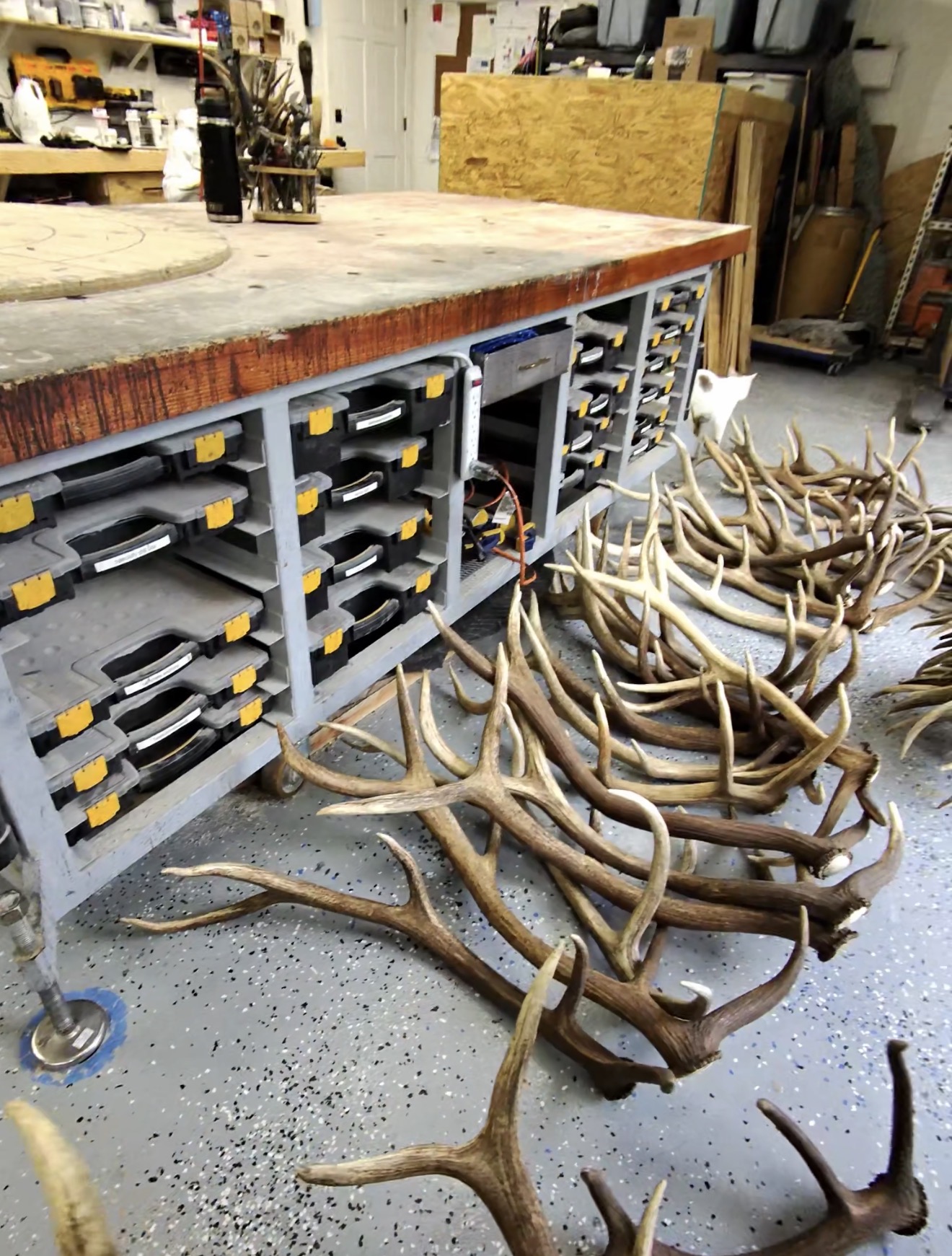
- Dante selects and rejects, laying out far more antler than the build will use.
- The chandelier is built around the antler that made the cut.
Key points
- Antlers are shed and regrown every year. The antlers we purchase are naturally shed, and the animal grows a new set during the next growth cycle.
- Antler is true bone, and it grows rapidly.
- Shed-collection rules vary by state and land manager. Seasonal closures and access restrictions can help protect wildlife from disturbance.
- Antler on the ground can fade, crack and get gnawed by rodents. Condition matters more than an assumed age.
- We buy high-quality craft-grade antler from our brokers, then hand-select the pieces for each fixture.
- Our natural-finish chandeliers retain natural color variation. A bleached-white finish is a separate option, not an indication of antler age or quality.
- We build with five species—elk, whitetail, mule deer, fallow deer and moose. Our brokers typically source these from the regions and managed herds described below.
- One honest exception: antler you send us for a custom build comes from wherever you got it. See the customer-supplied-antler section.
Are deer killed for antler chandeliers?
Not for the antler we buy. Every piece we purchase is a natural shed, picked up off the ground after the animal dropped it. Deer, elk and moose shed and regrow antlers as part of an annual cycle. The antlers are not removed from animals for our lighting.
The reason this works is a distinction people often miss: antlers are not horns. Most horns have a bony core covered by a keratin sheath and are retained throughout the animal’s life. Antlers are bone grown from pedicles on the skull, shed, and regrown annually. There are exceptions to the usual horn pattern: pronghorn shed their outer horn sheaths, but retain the bony cores. Collecting naturally shed antlers does not require removing them from a living animal.
It is worth asking any seller this directly, because not all antler on the market is shed antler. Some comes from hunted animals, some from culls, and a good deal of what is sold as “antler” décor is resin casting. We buy naturally shed antler, and where a component such as a socket cover is resin rather than real antler, we say so on the product page rather than leaving you to discover it.
For the company standards, see our sourcing and certification facts. For material identification, read real versus faux antler chandeliers.
Why do deer, elk and moose shed their antlers every year?
Seasonal changes in daylight help regulate the hormonal cycle behind antler growth and shedding. As testosterone falls after the breeding season, the attachment at the base of the antler weakens. The antler drops off, leaving the bony pedicle on the skull to grow the next set from.
The trigger is the seasonal cycle, not simply cold weather. Changing day length is sensed through the eyes and helps regulate the hormones involved. At the junction where antler meets pedicle, the bone-to-bone connection deteriorates. The antler falls on its own, or breaks free when the animal knocks it against something.
Then the whole thing starts again. Regrowth begins in late winter or spring and continues through summer. Antlers are rapidly growing bone rather than hair, horn or keratin. The size of the next set depends on factors including age, genetics and nutrition; it is not necessarily larger than the previous set.
Two details shed hunters depend on: an individual animal tends to drop around the same time each year, and the two sides often fall close together in time. That is why matched pairs may turn up near one another, and why a hunter who finds one side will search hard for the other.
So are shed antlers a renewable resource?
Yes, in the sense that antlers regrow annually and can be collected after they have naturally fallen. A new set does not have to be larger than the last for that cycle to continue. Responsible collection still matters: naturally shed material should be gathered without disturbing wildlife or entering closed areas.
When do antlers drop?
Moose drop earliest, from late November into December. Whitetail and mule deer drop from mid-December through early April. Elk are latest, from January into April, with most bulls dropping in March. Timing shifts with latitude, age and the animal’s condition—a healthy animal generally holds its antlers longer.
| Species | Typically sheds | Peak |
|---|---|---|
| Moose | Late November–December | December |
| Whitetail deer | Mid-December–early April | January–February |
| Mule deer | Mid-December–early April | January–February |
| Elk | January–April | March |
Region shifts it too. In the Northeast most whitetails have dropped by early February; across the Southeast the spread is much wider, with some areas running into April depending on when the local rut happened. This staggering is a large part of why antler supply is seasonal and why a particular species is not always available in a particular size at the moment a build is scheduled.
Where do shed antlers come from?
Different species come from different parts of the continent. Our brokers typically source elk from the Rocky Mountains and the Pacific Northwest, mule deer from the Rockies and the wider western states, whitetail from the eastern and central United States, and moose from Canada and Alaska. The fallow antler they supply typically comes from managed herds rather than wild range.
These are the usual sourcing regions for the antler our brokers supply, rather than fixed or exclusive origins for every piece. The geography follows the animals, and it explains a good deal about the supply.
| Species | Where our brokers typically source it |
|---|---|
| Elk | Rocky Mountains and the Pacific Northwest |
| Mule deer | Rocky Mountains and the western United States |
| Whitetail | Eastern and central United States |
| Moose | Canada and Alaska |
| Fallow deer | Managed herds rather than wild range |
The Rocky Mountain West and the Pacific Northwest—elk and mule deer
Elk and mule deer summer high and drop to low-elevation winter range when the snow comes, which concentrates large numbers of animals into relatively small areas through the months they are shedding. That concentration helps explain both the supply of antler from the West and the importance of protecting wintering animals from disturbance. Our brokers typically draw elk and mule deer antler from these regions, with mule deer also coming from the wider western states.
The eastern and central states—whitetail
Whitetail range covers most of the continent, and whitetail sheds are correspondingly dispersed: farm country, woodlots, river bottoms, field edges. Rather than the concentrated winter ranges of the West, they are found in ones and twos across a very large area. Shed hunters work bedding areas on south-facing slopes, food sources, the trails between them, and fence and creek crossings, where the jolt of a jump can knock a loose antler free. Our brokers typically source whitetail from the eastern and central United States.
Canada and Alaska—moose
Moose antler is a different proposition again: heavy, broad and palmated, dropped early in the season, and found in far smaller numbers than deer or elk antler. Canada and Alaska are our brokers’ typical sources, and moose is the scarcest of the species we work with.
Managed herds—fallow deer
Fallow are not native to North America. The fallow antler our brokers typically supply comes from managed herds—ranches, estates and parks, in the US and abroad—rather than from wild range. It has a distinctly different look and supply pattern from the native species.
We buy from a small number of brokers rather than from individual finders, and those brokers aggregate across these regions. That is how we obtain the species, size and condition a build needs—and, critically for us, matched left and right sides.
Which species do we build with?
Five: elk, whitetail, mule deer, fallow deer and moose. Which appear in a given piece depends on the fixture—our chandeliers are built from elk, whitetail, mule deer and fallow deer, and our wall sconces from elk, whitetail, mule deer and moose. Each species has a different scale and character, so it suits the room as much as the design does.
Species is largely a question of scale and shape:
- Elk—heavy and long-beamed. Carries the large multi-tier pieces built for great rooms and high ceilings.
- Whitetail—fine, closely spaced tines. Suits smaller fixtures and tighter rooms.
- Mule deer—sits between the two, with the forked branching characteristic of the species.
- Fallow deer—palmated, broad and flattened, and reads as a very different object.
- Moose—the broadest and flattest of all, and the scarcest of the five. We use it in sconces.
Availability moves through the year, because we work from what our brokers actually hold when a build is scheduled. You can see how each species reads at real size across the full range of antler chandeliers.
For a closer comparison of shapes and scale, see our antler species guide.
Who collects shed antlers?
Shed hunters—people who walk winter and spring range looking for antlers that animals have dropped. They collect fallen antlers rather than hunt the animals, following the collection and access rules for the area. They sell what they find to brokers, who sort it and supply furniture, lighting and craft buyers.
It has become a serious pursuit in its own right. People cover long distances across winter range, often with dogs trained to find antler, and the best material moves fast once it reaches a broker. For some it is a spring ritual; for others it is real seasonal income.
The chain from there to us is short: shed hunter, broker, our order. We are buying the output of a lot of people walking a lot of ground.
When are shed hunters allowed to collect—and when are they prohibited?
Shed-collection rules vary by state and land manager. Requirements may include seasonal closures, access restrictions, educational certificates, or licenses. Collectors should check the current rules for the specific place they intend to visit.
The closures protect the animals, not the antlers. Deer and elk on winter range are living on fat reserves, and being repeatedly pushed to move burns energy they cannot readily replace at that time of year.
This is a part of the supply chain a buyer rarely sees. Collecting can disturb animals even though the antlers have already fallen. People walking through winter range can push animals off feed and out of cover when they can least afford it. Responsible collection means respecting wildlife, landowner permission and any restrictions that apply to the location.
What happens to an antler left on the ground?
It can fade, crack and get gnawed. Squirrels, mice, voles, rats and porcupines gnaw shed antler for its minerals—it is roughly 19% calcium and 10% phosphorus, along with nine other mineral elements—and to wear down teeth that never stop growing. Sun and weather lighten the surface and can open cracks.
A shed does not stay in the same condition indefinitely. Its surface may become lighter, rougher or chalky, and cracks or chew damage may develop. How quickly that happens varies with exposure and conditions, so color alone does not establish how long an antler has been on the ground.
The rodents are not vandals here—they are helping return minerals to the ecosystem. For a builder, the important question is the condition of the actual piece, not an assumed age based on its color.
Why are antlers different colors?
Natural antler color reflects how the animal lived and what happened to the antler after it was shed. Blood remaining on the surface during velvet shedding, sap and plant compounds from rubbing, genetics, age and weather can all affect its appearance.
This is one of the more interesting things about the material, and it is worth understanding before you choose a fixture, because natural color variation has a history.
- Velvet shedding. Antlers grow under a living skin called velvet. Blood remaining on the surface when that covering is shed can contribute to darker color.
- Rubbing. Through the autumn, bucks rub their antlers on trees. Sap and plant compounds can affect their appearance; pine sap can darken antler.
- Age and rubbing behavior. How much an animal rubs can influence the color of its antlers.
- Genetics. Some animals are predisposed to lighter or darker antler.
- Weather during velvet shedding. Rain can affect what remains on the surface and the resulting color.
- Time on the ground. Sun and moisture can lighten antler after it has been dropped. The extent of weathering depends on exposure, not simply a fixed number of months or years.
Our natural-finish chandeliers retain the antlers’ natural color variation. We also offer a bleached-white finish for customers who prefer a lighter appearance. This is a separate finish option, rather than a description of the antlers’ age or quality.
How is shed antler graded?
Brokers assess shed antler by factors such as color, surface condition, cracks, broken tines and chew damage. Grade names and acceptable defects vary by buyer. We buy high-quality craft-grade antler from our brokers, then assess each piece for the fixture we are building.
The descriptions below are an illustrative overview of conditions a buyer may encounter, not a universal grading system or a way to date an antler. A grade label alone does not determine whether a piece is right for a chandelier.
| Illustrative condition | What it may look like | What matters for selection |
|---|---|---|
| Brown, sound material | Retained natural color and an intact surface, with limited visible damage | Condition, size, shape and compatibility with the fixture |
| Brown, with cosmetic damage | Natural color with chips, a broken tine or chew marks | Whether the damage affects the part needed for the design |
| Pale, sound material | A lighter surface without obvious severe deterioration | Actual condition, rather than color alone |
| Weathered or damaged material | Visible wear, chew damage, broken tines or surface deterioration | The extent and position of damage, and whether the piece is suitable |
| Chalky or deteriorated material | Deep cracks, a rough surface or crumbling areas | Deterioration that makes it unsuitable for our chandelier builds |
Our purchasing standard is high-quality craft-grade antler. We do not treat a grade name as proof of how recently a piece was shed. The final decision comes from inspecting the material and selecting it for a particular build.
What happens to the antler we don’t buy?
Different buyers have different requirements. Antler that does not suit a chandelier may still suit another project, depending on the condition of the usable material. That does not mean every rejected or damaged piece is suitable for another use.
For us, the focus is on buying material that meets our needs and paying for the quality, size and selection each fixture requires.
What makes an antler good enough for a chandelier?
High-quality craft-grade antler is our starting point; it does not automatically go into a fixture. Dante rejects pieces with cracks, insect damage or heavy weathering, then selects what is left for size, color and the curve each piece needs to contribute. Far more antler is laid out for a build than ends up in it.
This is the step that separates one antler chandelier from another, and it is worth explaining properly, because it is invisible in a finished photograph.
First, what gets rejected
- Cracks. A crack is a structural question on a piece that will hang overhead, and it can open further as the antler dries indoors.
- Insect damage. Pitted or bored surfaces.
- Heavy weathering. Chalky, rough, deteriorated surfaces that are unsuitable for the build.
- Chew damage in a visible position. A gnawed base may be usable where it is hidden; a gnawed tine on the outside of a fixture is not.
Then, what gets selected
- Matched lefts and rights. This is the one most people never think about. Every rack is asymmetrical, and a left antler and a right antler curve in opposite directions. For our layouts, we order balanced quantities of lefts and rights rather than simply buying by weight.
- Color consistency. Antler is naturally variable, so pieces are grouped so the variation across a finished fixture reads as intentional rather than as mismatched stock.
- Size and scale. The tiers of a multi-level fixture need antler of related but deliberately graded size.
- Sweep and how tines will sit. Each piece has to work against its neighbors, not fight them.
- How it reads from below. A hanging fixture is seen from underneath far more than from the side, and an arrangement that photographs well at eye level can look wrong from a dining chair.
So a build starts with sorting, not cutting. Antler that does not suit one fixture goes back on the rack and waits for another. Because we work from what brokers actually hold at the moment a build is scheduled, and because selection is this specific, every fixture is made to order rather than pulled from a shelf. Check the relevant product page for the current production timeline, or contact us about your project. Shipping time is additional.
Why are some antler chandeliers more expensive than others?
Mostly the antler. A large fixture needs more antler, in bigger pieces, with matched sides and the right condition, color and shape. Species matters too: a big elk rack is a different purchase from a whitetail shed. Selecting and arranging those pieces also takes time.
The things that actually move the price:
- Quality. Sound, visually suitable material is a different purchase from heavily weathered or damaged antler.
- Size. Large antler is disproportionately scarce—it comes from mature animals, of which there are fewer.
- Species. Elk carries the big fixtures and is priced accordingly; whitetail suits smaller pieces.
- Matching. Buying in matched sides at a consistent color and size costs more than buying antler by the pound.
- Quantity. A multi-tier fixture is not simply more antler than a single tier—it is more antler that all has to work together.
- Build time. Selection and layout on a large piece take real hours before any assembly starts.
What about antlers you send us?
Antler that a customer sends us for a custom build comes from wherever that customer got it—which may include their own hunts, or a family collection going back generations. We do not ask, and we do not represent those builds as naturally shed. The distinction matters, so we state it plainly: antler we buy is naturally shed, and antler you send is yours.
Most of the antler people send us has a story attached. A rack from a hunt with a father who has since died. A collection picked up off the same piece of land over thirty years. Sheds found by a child who is now grown. Those builds are among the most meaningful work we do, and it would be dishonest to fold them into a blanket claim about sourcing.
So the claim we make is specific rather than sweeping. Every antler we purchase for our own fixtures is a natural shed. When you send your own material, its origin is yours, and a fixture built from it is described as your antler, built into a chandelier.
Either way, the same selection standards apply: we will tell you honestly if a piece you have sent has cracks, insect damage or weathering that makes it unsafe or unsuitable to build with.
More about building with your own antlers.
Speak With the Builder
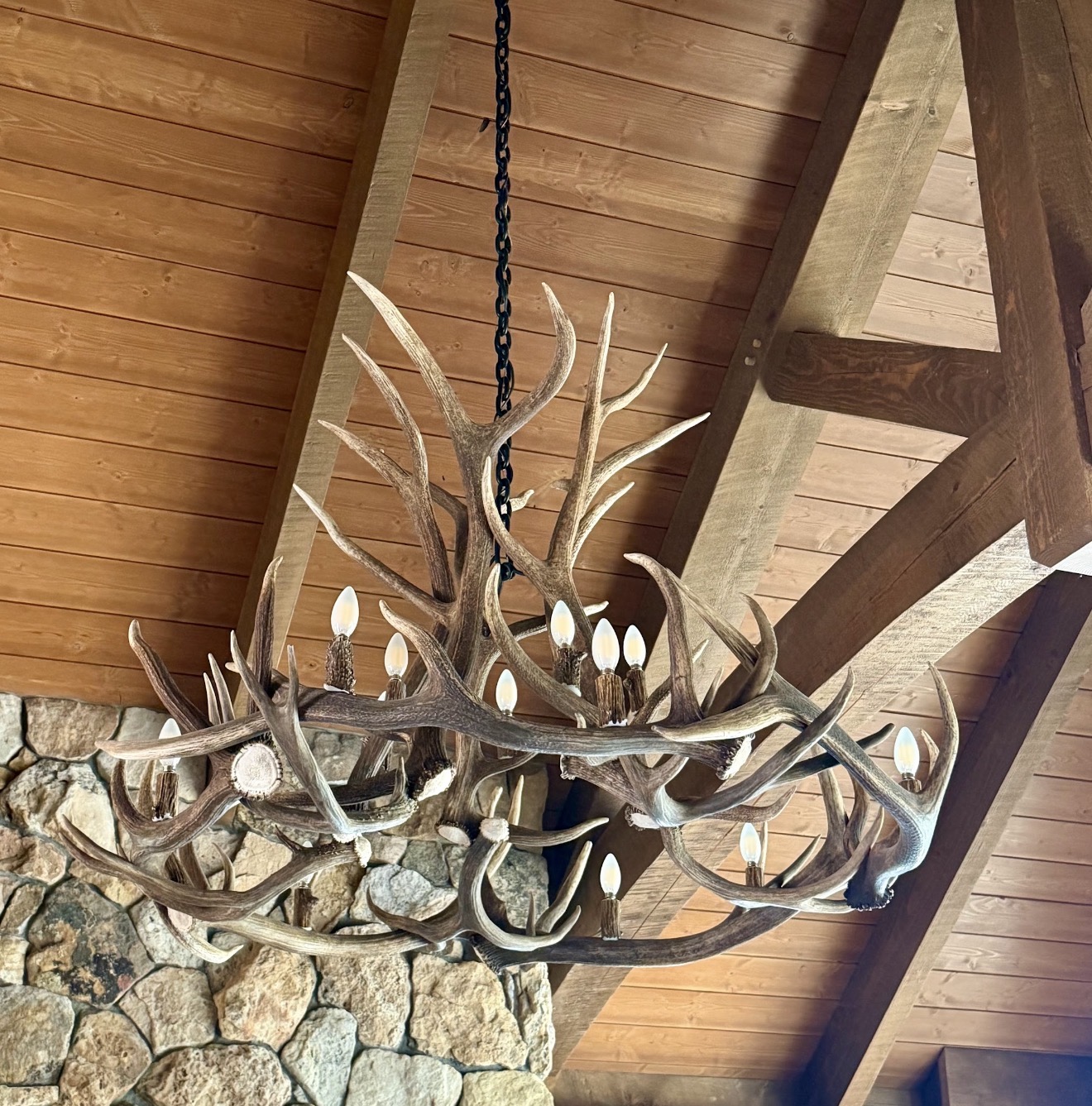
Browse our antler chandeliers or contact Dante about your project.
Frequently asked questions
Are deer killed for antler chandeliers?
Not for the antler we buy. Every piece we purchase is naturally shed and collected off the ground, not removed from animals for our lighting. Antler a customer sends us for a custom build comes from that customer and may include hunted animals. We keep those sources distinct.
Do antlers grow back?
Yes. Antlers are shed and regrown as part of an annual cycle. They are rapidly growing bone, and the size of the new set depends on factors including age, genetics and nutrition. A new set is not necessarily larger than the previous one.
Is antler the same as horn?
No. Most horns have a bony core with an outer keratin sheath and are retained throughout life. Antlers are bone that is shed and regrown annually. Pronghorn are an exception to the usual horn pattern: they shed their outer horn sheaths but retain the bony cores.
Where are shed antlers found?
It depends on the species. Our brokers typically source elk from the Rocky Mountains and the Pacific Northwest, mule deer from the Rockies and the wider western states, whitetail from the eastern and central United States, and moose from Canada and Alaska. The fallow antler they supply typically comes from managed herds. These are usual sourcing areas, not fixed origins for every piece.
Why is shed hunting regulated in some states and not others?
Rules reflect local wildlife needs and land-management requirements. Collectors can disturb animals on winter range even when they are only picking up fallen antlers. Requirements may include seasonal closures, access restrictions, educational certificates or licenses. Check the current rules for the specific place you intend to visit.
Why are some antlers dark brown and others almost white?
Natural color varies with factors such as velvet shedding, rubbing against vegetation, genetics and weather exposure. Lighter color alone does not establish an antler’s age or quality. Our natural-finish chandeliers retain natural color variation, while our bleached-white finish is a separate option for customers who prefer a lighter appearance.
What makes an antler good enough to build with?
We buy high-quality craft-grade antler from our brokers. We then inspect for cracks, insect damage and heavy weathering, and select for the right size and curve, matched left and right sides, color consistency and how the piece reads from below.
What happens to antler that isn’t good enough?
A piece that does not suit one use may suit another, depending on its actual condition. Material with serious damage or deterioration should not be assumed suitable for another product. Within our workshop, sound pieces that do not fit one design may be saved for a different build.
Are shed antlers renewable?
Yes. Antlers regrow annually and naturally shed antlers can be collected after they fall. Responsible collection still means avoiding disturbance to wildlife and following the rules for the location.
Sources and further reading
- Rocky Mountain Elk Foundation—when and why bulls and bucks shed their antlers. Shedding timing by species.
- National Deer Association—what determines a buck’s antler color. Velvet shedding, rubbing and natural color variation.
- National Deer Association—why squirrels gnaw on shed antlers. Mineral composition and which animals consume cast antler.
- The science behind sheds. Photoperiod, testosterone and the pedicle.
- Wyoming Game & Fish Department, Colorado Parks & Wildlife and the relevant state wildlife agency and land manager—current collection and access rules.
Shed-collection rules vary by state and land manager and may change. Check current requirements for the specific place you intend to collect.

 Estimated build time: 6–10 weeks from order confirmation. Shipping time is additional.