

Antler Chandelier Installation Guide
How to plan weight, ceiling support, hanging height and chain length
Short answer: Start with the fixture weight and ceiling support. A chandelier weighing more than 50 lb needs support independent of the outlet box unless the box is listed for at least that weight. A lighter fixture still needs a suitable, securely installed support. Have a qualified electrician confirm the plan before delivery, and use the steps below to measure height, drop and chain length.
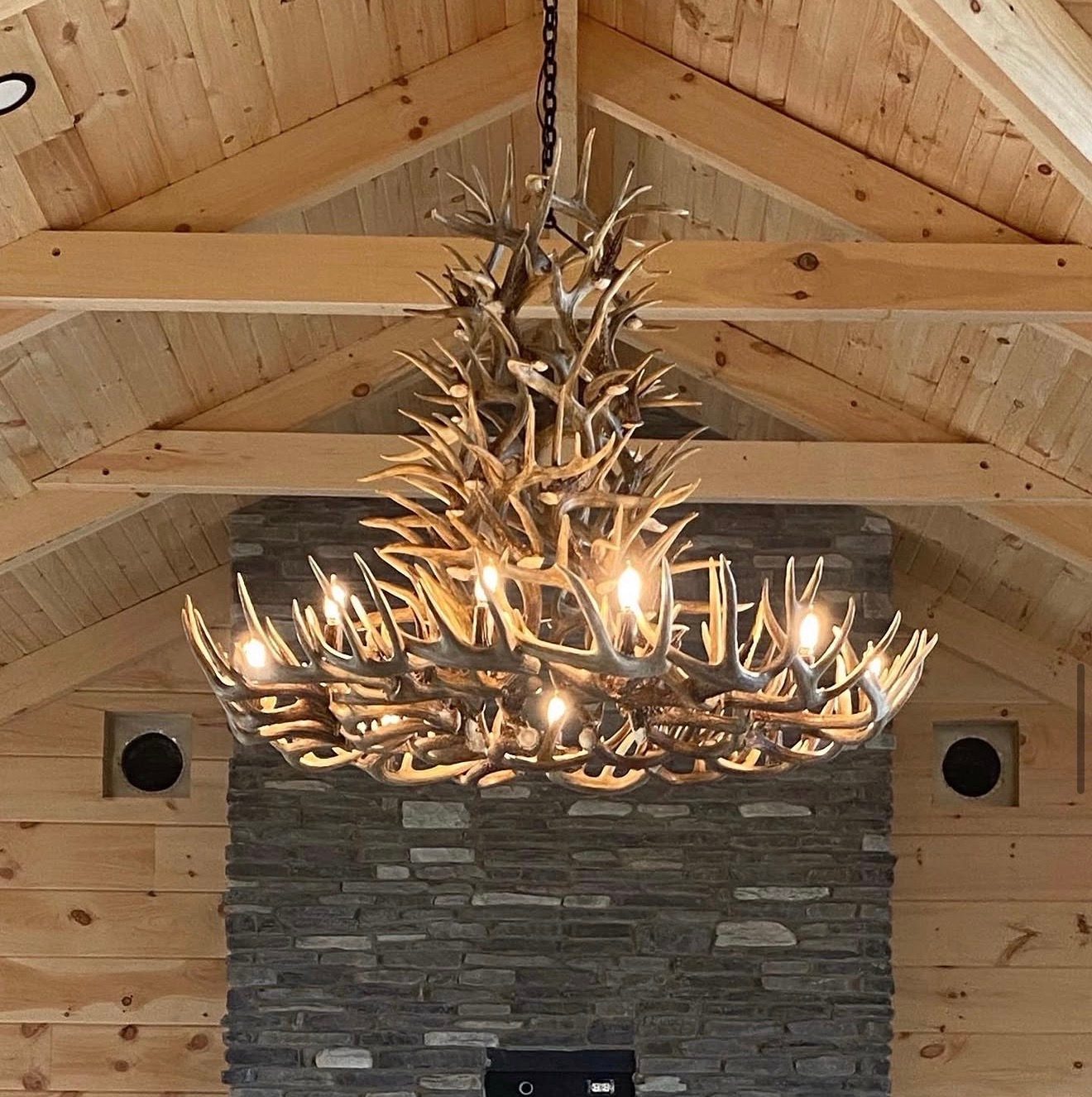
A real antler chandelier has an irregular shape and a wide span. Good preparation makes it easier to move, support and position without damaging the antlers. This is a planning guide, not step-by-step wiring instructions: it explains what to measure before ordering and what to arrange with your installer.
Every fixture is hand-built in our Georgia workshop by Dante, our owner and master builder. If anything about your specific piece is unclear, he can confirm it before installation.
What should I check before ordering?
- Ceiling height: measure at the exact hanging point, especially on a vaulted ceiling.
- Fixture size and weight: check the maximum overall dimensions and weight for your selected configuration, including optional accessories. Both are on the fixture specification sheets; the antler chandelier size guide helps you choose the right scale for the room.
- Existing support: ask an electrician to inspect the outlet box, mounting hardware and structural attachment. An existing light does not prove the support is suitable for a heavier chandelier.
- Suspension length: calculate the overall drop, then confirm chain, wire and mounting-hardware allowances before ordering.
- Delivery route: measure doorways, stairs, turns and access to the hanging point. Include protruding tines; do not assume the fixture can be folded or disassembled.
- Access and lifting: discuss crew size, scaffolding or lifting equipment with the installer before delivery.
Build time is typically 6–10 weeks from order confirmation. Schedule installation after delivery and inspection rather than around an estimated ship date.
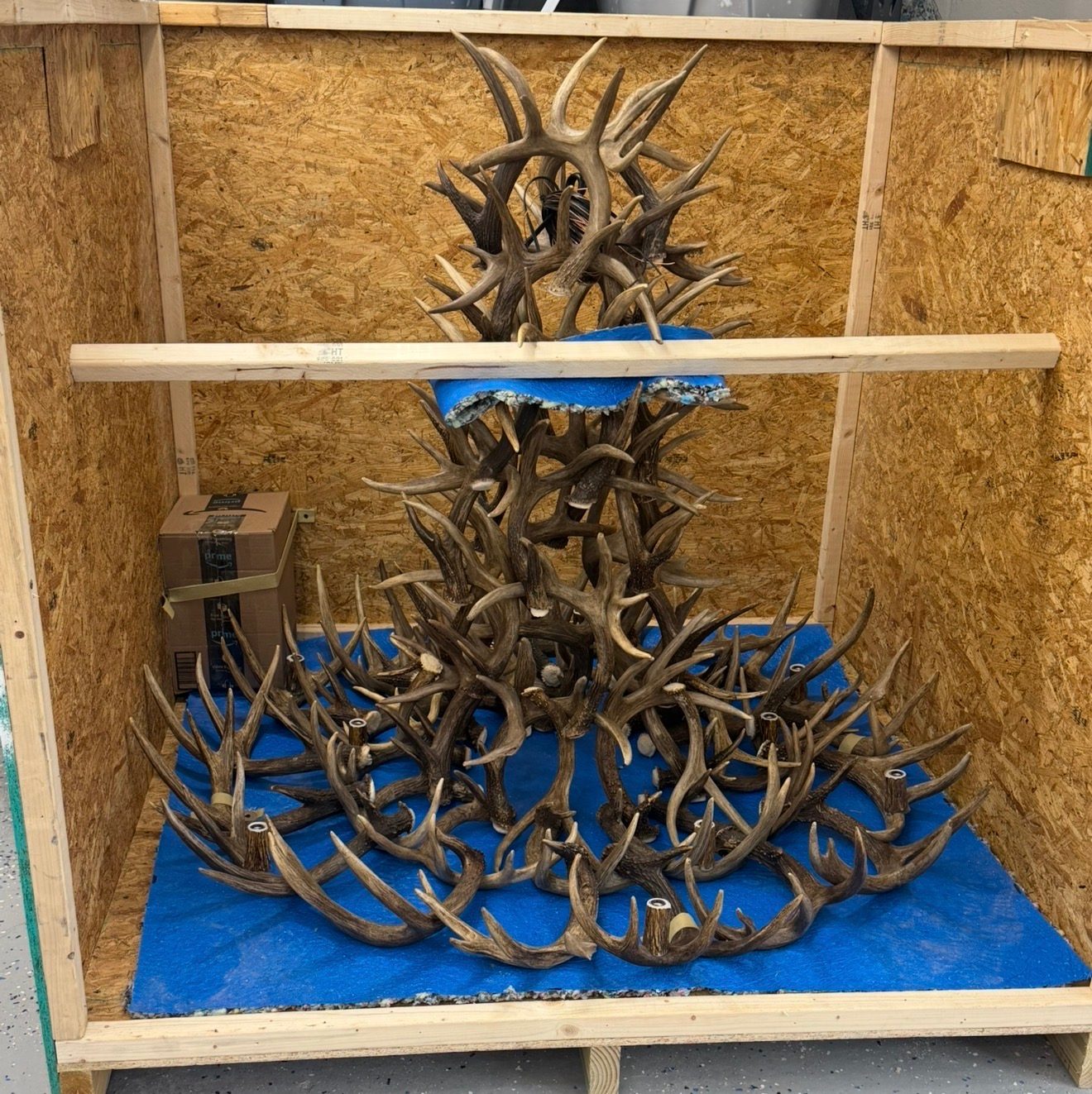
Every chandelier ships in a custom wooden crate. Freight includes basic insurance plus liftgate and residential delivery at no extra charge.
Will my ceiling hold the chandelier?
The entire load path matters: fixture attachment, chain, connectors, mounting hardware, outlet box when used for support, fasteners and structural framing. A solid-looking ceiling, or an old fixture that has stayed in place, is not a capacity check.
| Installed weight | What the installer must confirm |
|---|---|
| 50 lb or less | The box or separate support is suitable for luminaire support, securely installed and adequate for the actual load. |
| More than 50 lb | Independent support, unless the outlet box is listed for at least the weight to be supported. Verify its markings and mounting instructions. |
This summarizes the NEC outlet-box support provision. The adopted code edition and local requirements govern. Follow any fixture-specific requirement for structural anchoring even when the fixture weighs less than 50 lb. [1]
Independent support means a verified connection to appropriate building structure. It is not simply adding a brace near an electrical box. The installer must establish which components carry the load and verify their capacities and attachments.
Where do I find the weight?
Fixture weights are published on our specification sheets. Because each fixture is handmade, the client can request the completed fixture’s final weight at completion. Share that weight with your installer and account for the full supported load, including suspension hardware and accessories. Do not substitute crated shipping weight for installed fixture weight. [4]
Who arranges installation?
The client is responsible for hiring and paying a qualified electrician or handyman to install the chandelier. Choose someone experienced with hardwired lighting and the weight and scale of your fixture. Electrical work must be completed by a person authorized to perform it under local requirements. The installer is responsible for assessing ceiling support, selecting a suitable mounting method, completing grounding and wiring, and checking permit or inspection requirements. Structural work may also require a qualified contractor or engineer, depending on the building and fixture.
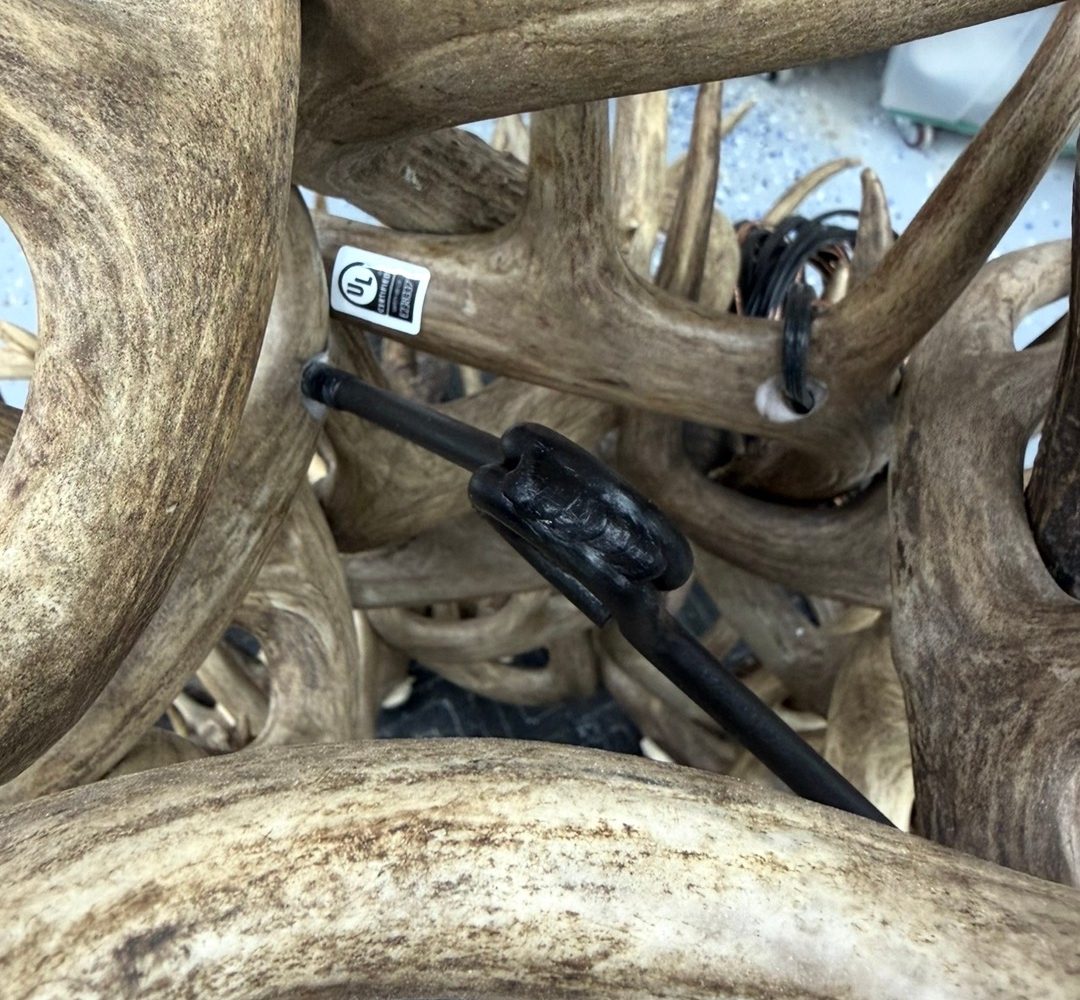
UL certification: every chandelier, pendant and wall sconce we build is UL Listed for the United States and Canada under File E238337, including custom and Use Your Antlers builds. For commercial or permitted work, provide the fixture specifications and listing information before installation. The fixture label and current certification record govern. Learn more in our guide to UL Listed antler chandeliers. [4]
What mounting hardware is included?
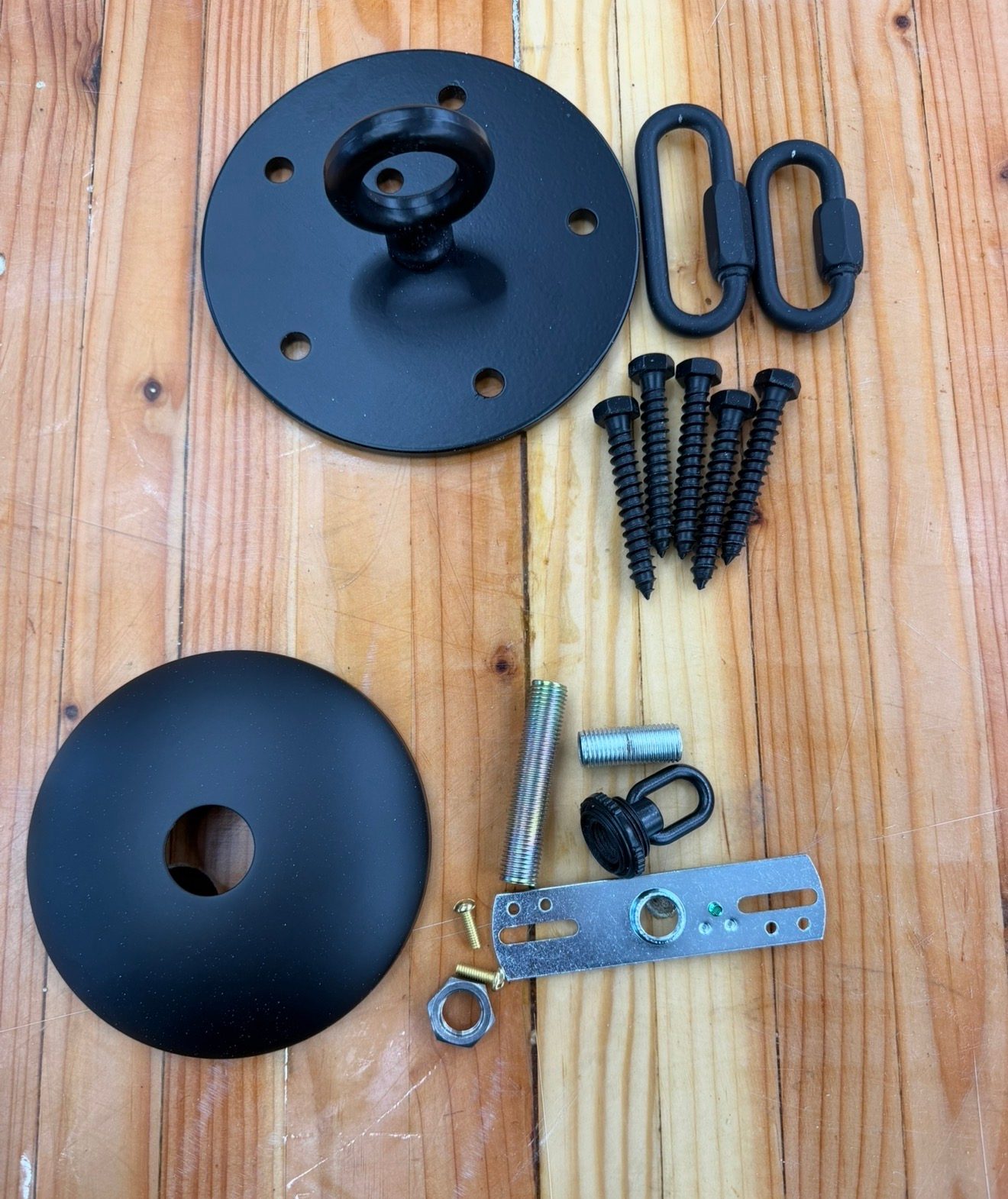
Hanging hardware is included with every chandelier: heavy-duty hanging hardware for heavier fixtures and standard hardware for fixtures under 50 pounds. Hardware alone does not establish a safe working load or an adequate structural attachment, so the installer confirms the complete assembly, including connector ratings and fastener diameter and embedment, before installation.
Fixtures under 50 lb
Use a ceiling outlet box identified for luminaire support and adequate for the actual load. Suitable metal and nonmetallic boxes exist; ordinary device boxes are not interchangeable with fixture-support boxes. Use the mounting screws specified for the box and bracket. A conventional crossbar may use No. 8-32 machine screws where the box and bracket are designed for them. [1, 5]
Heavier fixtures and structural attachment
Above 50 lb, use verified independent support unless a box is listed for the full supported weight and the complete mounting arrangement is suitable. A joist connection, structural blocking or a listed brace assembly must suit the building and the actual load. A fan-support rating alone does not establish adequate chandelier capacity. [1, 5]
The installer confirms how the supplied parts suit your ceiling, including lag-bolt diameter, embedment in sound framing, edge distances and load capacity.
Grounding and strain relief
- Grounding: the installer connects the fixture equipment-grounding conductor to the circuit equipment-grounding conductor using suitable listed connectors, and bonds a metal box and any bracket or other metal parts that require bonding. Do not substitute the neutral conductor for grounding. [1]
- Chain-hung fixtures: the chain and mechanical attachments carry the weight. Route wires through the chain and canopy as specified, without tension, pinching or abrasion. Chain routing does not replace required strain relief or protection at openings.
How high should an antler chandelier hang?
Over a dining table, 30–36 inches from the tabletop to the lowest part of the fixture is a common starting point at an 8-foot ceiling. Assess sightlines and the actual antler profile before fixing the final height. Higher ceilings may call for a higher placement, but a fixed increase per foot is not a code rule. [2]
Where people walk underneath, use at least 7 feet of clearance as a residential starting point, measured to the lowest antler or other protrusion. The installer must check local clearance requirements; stairs, landings and commercial circulation may need different treatment. [2]
In a two-story entry, assess the fixture from both floors and check stairs, doors, windows and nearby walls. Position the fixture so its outermost tines stay clear of walls, doors and traffic paths. For room-by-room sizing, see the size guide.
How do I calculate chain length?
Available suspension space = ceiling height − desired bottom height above the floor − listed fixture height (including hanging loops).
Chain length = available suspension space − the drop of the canopy and any connectors or mounting hardware not included in the listed height.
Listed fixture height includes the hanging loops. The client chooses the overall hanging drop for the room, and the installer adjusts chain length to achieve it. Use the same units throughout and do not subtract the included loops a second time.
Worked example
Ceiling height 120 inches; table height 30 inches; desired clearance above the table 36 inches; listed fixture height, including hanging loops, 38 inches.
- Desired bottom height: 30 + 36 = 66 inches above the floor.
- Total ceiling-to-bottom drop: 120 − 66 = 54 inches.
- Space above the fixture and loops: 54 − 38 = 16 inches.
- Those 16 inches cover chain plus mounting hardware. If the hardware adds a 4-inch drop, the chain allowance is 12 inches. Confirm actual hardware dimensions before ordering.
Published specification sheets show 6-, 10- and 20-foot chain options. Confirm the options and matching wire length for your fixture. The installer can shorten chain using the approved method. A longer drop or added chain requires Dante to confirm compatible, load-rated components and adequate wiring; do not splice or extend it casually. [4]
What is different about handling antler lighting?
- Plan from maximum dimensions. Natural antlers are irregular. Check the full width, length and height, including tines, against the delivery route and final location.
- Do not lift by tines, sockets or electrical wire. For chandeliers that require it, lifting-point guidance is provided at shipping. Share it with the delivery crew and installer before unpacking or moving the fixture. If a lifting point is unclear, contact Dante before handling it.
- Plan the crew and equipment around the actual fixture. Weight, span, ceiling height and access determine what is needed. Do not assume two people are enough for every installation.
- Protect protruding antlers. Keep tines clear of doorframes, stair rails and scaffolding. Do not force the fixture through a restricted opening.
- Choose orientation before final electrical connections. Check the appearance from the main viewpoints while the fixture is safely supported. Do not rotate a connected fixture in a way that twists or strains wiring.
- Investigate unexpected movement. A loose, tilting or shifting attachment should be inspected. Do not treat it as normal settling.
What should I send my electrician?
- Fixture model, selected options, maximum dimensions and confirmed weight.
- The included hardware and any available information about the ceiling structure.
- Canopy dimensions, suspension length and mounting-point details.
- Supply voltage, bulb base, light count and maximum lamp rating from the fixture label or current specification sheet.
- Ceiling height and slope, proposed bottom height, photographs of the location and any known structural information.
- Bulb model and dimmer model, if dimming is planned.
- UL information: File E238337 and the fixture label details.
If any specification is unclear or differs between documents, ask Dante to confirm it before installation: call (702) 861-8116 or contact us.
What happens on installation day?
Use this as a coordination checklist. The installer determines the mounting and wiring method for the actual fixture and ceiling support. [2]
- Inspect before installation. Unpack safely and check antlers, hardware and wiring for damage. Photograph and report any damage; do not install a damaged fixture. Keep the packing until the issue is resolved.
- Confirm the support and access plan. Verify weight, structural attachments and hardware. Arrange the planned crew and lifting equipment.
- Isolate power. The electrician switches off the supplying circuit at the breaker and verifies it is de-energized. A wall switch alone is not a safe shutoff.
- Prepare suspension and orientation. Set the chain length and assemble the mounting hardware. Support the fixture securely while work is in progress.
- Complete mounting and wiring. Maintain mechanical support during connections; electrical conductors must never carry the weight. Complete grounding and strain relief, avoid pinching wires and secure all connectors.
- Check before releasing support. Confirm attachments, canopy fit, clearance and stable suspension, with no twisted or strained wiring.
- Fit approved bulbs and test. Do not exceed the fixture rating. Restore power only after installation is complete, then check operation and dimming.
Installation time depends on access, fixture size and whether support is already in place. Get a site-specific estimate rather than assuming a one- or two-hour job.
Can an antler chandelier hang from a vaulted or sloped ceiling?
Yes. In most cases, no special adapter or slope-specific mounting equipment is needed: our chain-hung chandeliers hang from sloped ceilings using the supplied hardware. Your installation professional can advise if your ceiling calls for something different. Measure ceiling height at the actual hanging point and choose the overall drop for the room. The installer still verifies structural support, canopy fit, stable vertical suspension and wiring protection.
Can I put an antler chandelier on a dimmer?
Yes. Dimmable bulbs are included with every fixture, and our chandeliers use E12 candelabra bases. Your installer should choose a dimmer compatible with the supplied bulb type and connected load, checking the dimmer manufacturer’s compatibility information for the exact bulb and dimmer models. [3, 4]
Use matching bulb models and color temperatures for a consistent look. Our specification sheets list 2700K and 3000K options; both read as warm white, with 3000K slightly less warm. [4]
Follow the maximum rating on the fixture label. For LED replacements, check the actual electrical wattage, not the incandescent-equivalent brightness on the package. Flicker, buzzing or uneven dimming can come from bulb compatibility, dimmer settings, loading or an installation issue, so have the electrician troubleshoot persistent problems. [3]
Frequently asked questions
Can I shorten the chain on an antler chandelier?
Yes, using the approved method. Confirm wire routing and the remaining hardware clearance with your installer.
Will an antler chandelier fit through my door?
Compare the full fixture envelope, including tines, with the narrowest opening and every turn on the route. Ask Dante if a special delivery or assembly arrangement is needed.
Is a heavy-duty ceiling box enough?
Only when its listing, capacity, structural attachment and complete mounting arrangement are suitable for the fixture. The qualified installer verifies this; weight alone is not the whole support assessment.
Do I need an electrician to install an antler chandelier?
Yes. The client hires a qualified electrician or handyman authorized to do the work under local requirements. The installer verifies ceiling support, mounting, grounding and wiring.
Are your antler chandeliers UL listed?
Yes. Every chandelier, pendant and wall sconce we build is UL Listed for the United States and Canada under File E238337, including custom and Use Your Antlers builds.
Planning an installation?
Browse our real antler chandeliers, check sizes on the specification sheets, or contact us and Dante will help you plan the hang.
Sources and further reading
- NFPA 70 (NEC), outlet-box support provisions, commonly referenced as 314.27(A)(2) in recent editions. Verify the adopted edition locally. NFPA free code access
- Kichler Lighting: general chandelier installation, power shutoff and hanging height. Chandelier installation guide
- Lutron: exact bulb and dimmer compatibility. LED compatibility tool
- Antler Chandeliers & Lighting Company: published fixture specifications and UL listing. Confirm current details for the ordered fixture. Specification sheets
- ABB Carlon: example showing separate fixture and fan ratings and product-specific mounting provisions. Not a recommendation of a particular box. Ceiling-box ratings

