

Real vs faux antler chandelier — it is the question most shoppers never think to ask until the fixture is hanging in their dining room. Most antler chandeliers sold online are not made from antler. They are cast resin — molded polyurethane or polyresin, painted to look like bone — and many listings never say so directly. The fastest way to tell the difference is that no two arms on a real antler chandelier are identical, while a resin fixture repeats the same few shapes around the frame.
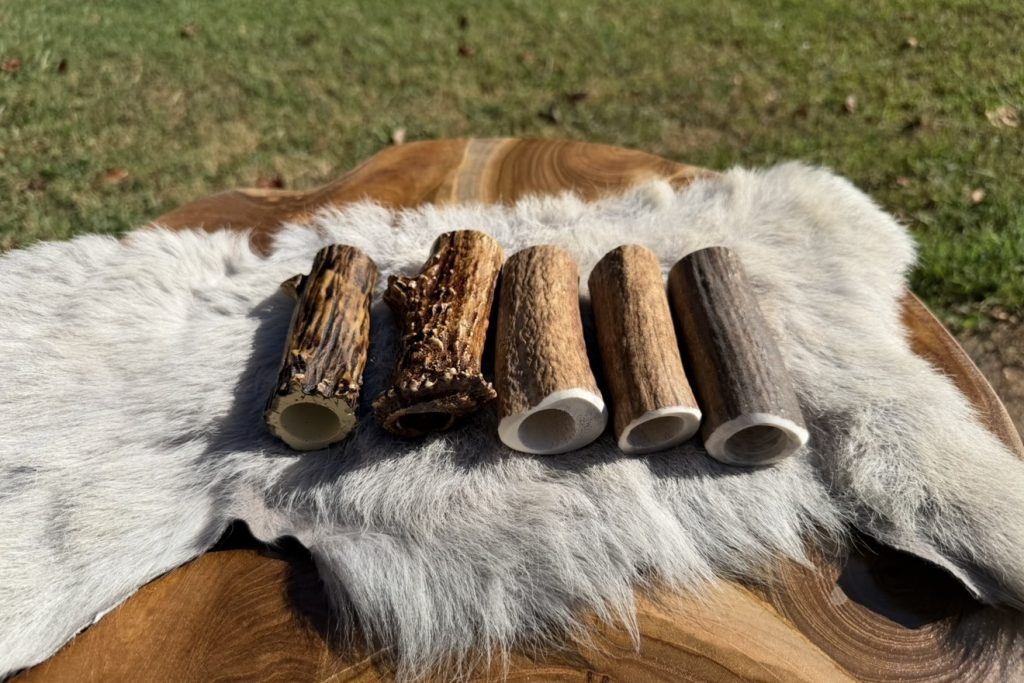
Real antler socket covers (right) show natural variation, while resin covers (left) have a more uniform, consistent look.
This guide covers what separates the two, how to check a listing before you buy, why the price gap exists, and the one safety question almost nobody asks.
Real vs faux antler chandelier: the seven-second test
Look at the photo. Find two arms of similar size and compare them point for point.
On a real fixture, they will differ — different tine counts, different curves, different lengths, different color. Antler is grown, not manufactured, and no two sheds match.
On a resin fixture, you will find repeats. Manufacturers cast from a small number of molds, usually three to six, and rotate them around the frame. Once you notice the repeat you cannot unsee it.
That single check settles most listings. The rest of this guide is for the ones it doesn’t.
Seven ways to tell real from faux
1. Repetition
Covered above, and it is the most reliable signal. Real antler has no repeats. Cast resin does.
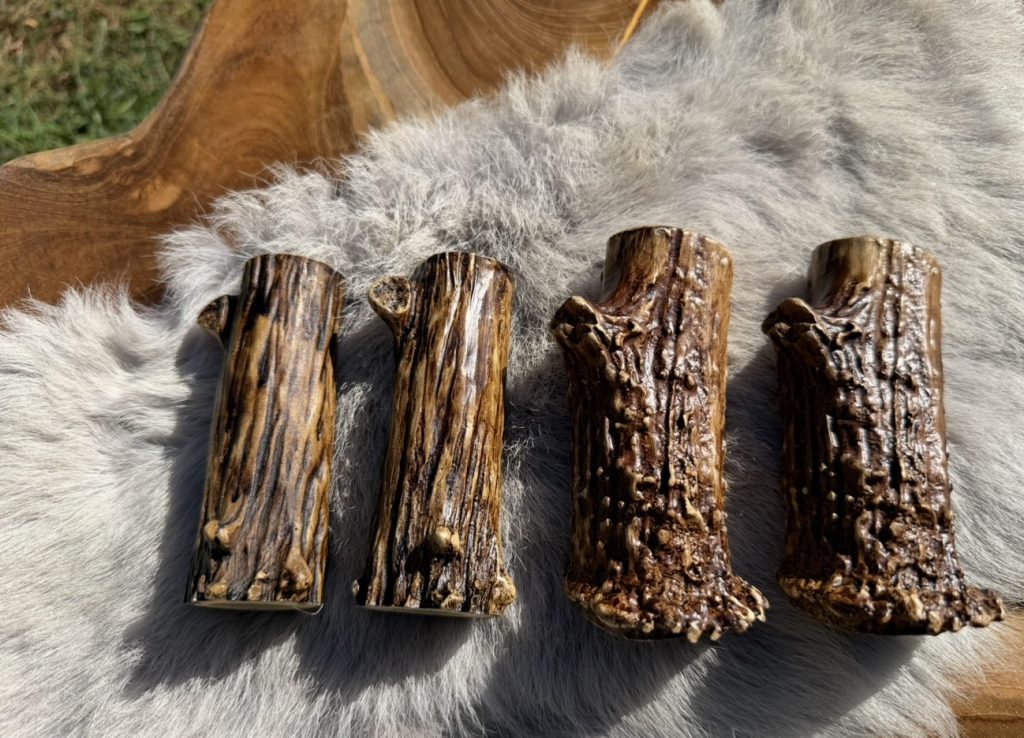
Resin socket covers are used as standard, offering a consistent look in a durable material.
2. Color variation
Real antler varies in color along its own length — darker toward the base, paler at the tines, with staining and weathering that differ from piece to piece depending on how long the antler lay on the ground before it was collected. A chandelier built from real antler shows that variation across the whole fixture.
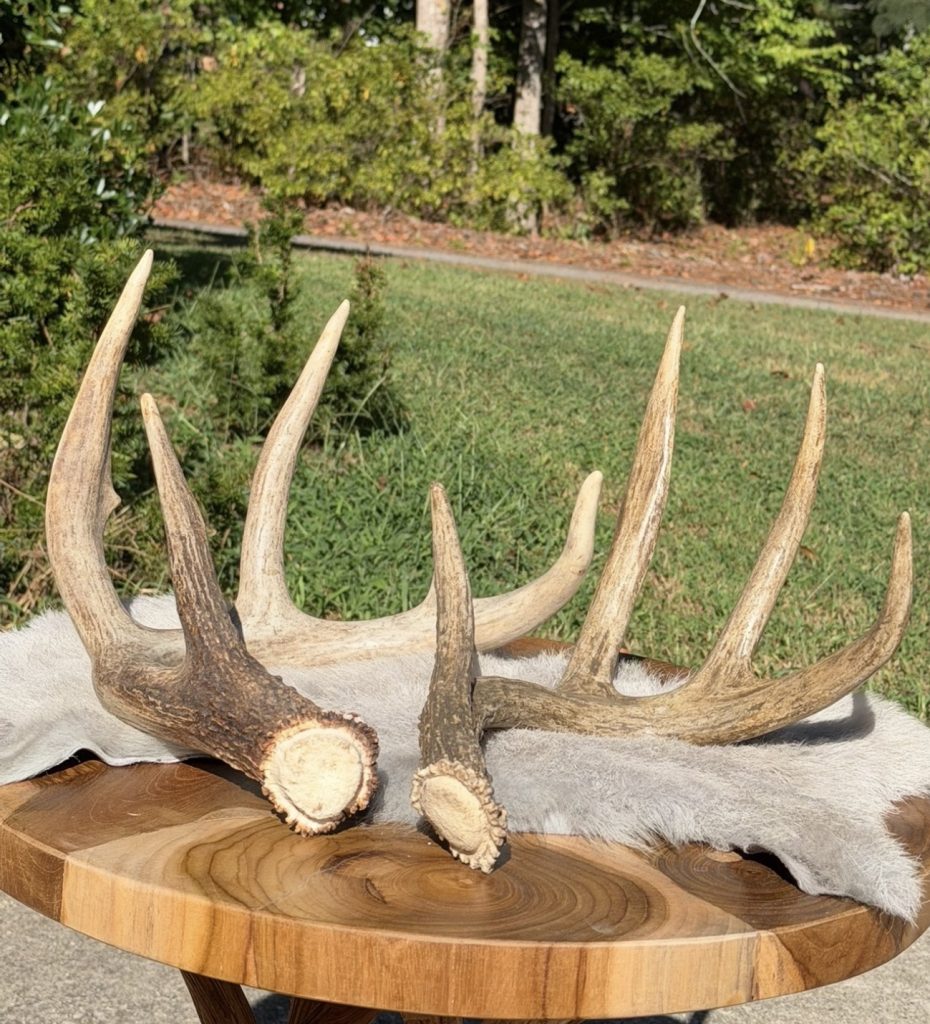
Every real antler is naturally shed or sustainably sourced, so no two racks are ever exactly alike.
Resin is painted, usually in a single pass with an applied wash to suggest aging. It reads as uniform. Photographed well it can look convincing; in a room, under light, it flattens.
3. Surface texture
Antler has a porous, slightly grooved surface, with the pearling — the bumpy ridged texture near the base — that forms as the antler grows. The burr where the antler detached from the skull has a distinctive rough crown.
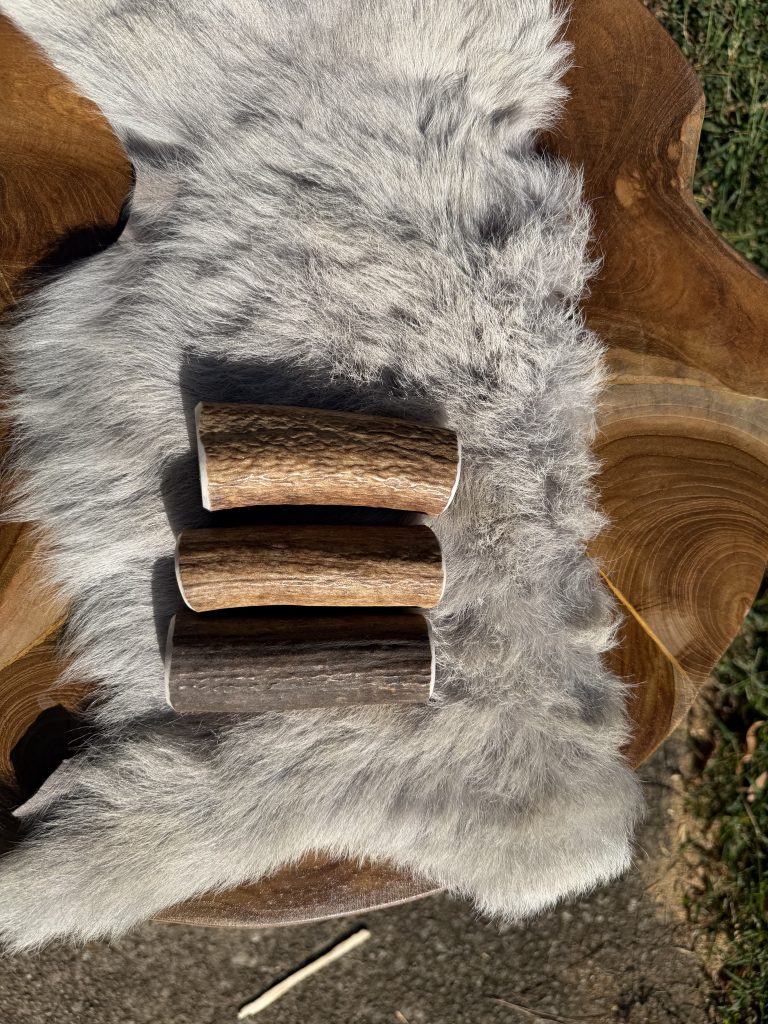
Real-antler socket covers show the same natural color and grain variation as the rest of the rack.
Resin reproduces texture only where the mold captured it, and mold seams often run along the length of an arm. Look for a faint straight line where two mold halves met. Antler has no straight lines anywhere.
4. Weight
Real antler is dense bone. A large real antler chandelier is a heavy object, and the listing should tell you how heavy, because installation depends on it. Anything over roughly 50 pounds needs a fixture-rated ceiling box mounted to a joist or to blocking, not a standard box.
Resin fixtures are markedly lighter. That is genuinely a selling point for resin — easier to hang, no structural question. But if a listing describes a five-foot chandelier as lightweight and easy to install, that tells you what it is made of.
5. Published weight and dimensions
Real antler varies, so a genuine maker will give you an approximate weight and a dimension range rather than one exact number. A resin manufacturer can give exact figures because every unit is identical.
Either is fine. What should concern you is a listing that gives no weight at all. On a fixture you are about to bolt to your ceiling, that omission is a problem regardless of material.
6. Price
Real antler chandeliers start in the high hundreds for the smallest pieces and run into five figures for large multi-tier fixtures. Ours run from around $495 for a small fixture to roughly $8,955 for the largest.
Resin fixtures typically sell for a fraction of that. If a five-foot “antler” chandelier costs $400, it is resin. The antler alone for a fixture that size costs more than that.
7. The language in the listing
This is where it gets deliberate. Watch for:
- “Antler-style,” “antler-look,” “faux antler,” “resin antler,” “cast antler” — these are all telling you it is not antler, in words most shoppers skim past.
- “Naturally shed” with no further detail — real, but check the rest.
- A listing that never names the material at all. On a genuine piece, the material is the whole selling point. Silence usually means resin.
- Species named specifically — elk, mule deer, whitetail, fallow, moose. Resin sellers rarely commit to a species because their molds are generic.
The safety question almost nobody asks
Here is a distinction that matters more than the material, and it is one you will have to dig for.
A chandelier can contain UL-listed sockets and UL-listed wire and still not be a certified fixture. Component certification and whole-fixture certification are different things. The components being certified says the parts met a standard on their own. Whole-fixture certification means the assembled fixture — the wiring as routed, the connections as made, the load as configured — was tested and is subject to ongoing inspection.
Many antler chandeliers, real and resin alike, are assembled from certified parts without the finished fixture ever being certified. It becomes a real problem in two situations: an insurance claim after an electrical incident, and any commercial installation, where an electrical inspector or a specifier will ask for the fixture’s certification and will not accept a parts list.
Our chandeliers, wall sconces and pendants are UL Certified for the United States and Canada under file E238337, including custom builds. The mark appears on the fixture itself. That covers the assembled fixture, not just its components.
If you are comparing us against another maker, this is a fair question to ask them: is the finished fixture certified, or are the parts certified? You are entitled to a file number, and a certified maker will give you one without hesitation.
(Note: our lamps are not covered under this file. We would rather say so than let a blanket claim stand.)
Where real antler actually comes from
The most common objection we hear is whether animals are harmed. They are not.
Elk, deer and moose shed their antlers naturally every year and grow a new set. The shed antlers are collected from the ground, largely on public and private land in the western United States, and this is a long-established practice with its own season and rules. No animal is killed or injured to supply a chandelier.
Antler is also, in a way that resin is not, a genuinely renewable material. It regrows annually.
When faux is the right choice
It would be dishonest to write this guide as though resin has no place.
Choose resin if the fixture is going somewhere the weight is a genuine problem, if the budget is firmly under a few hundred dollars, if you need multiple identical fixtures for a symmetrical installation, or if you want something for a short-term or seasonal setting.
Choose real antler if you want a fixture that is unique, that will hold its character for decades, and that reads as authentic at close range. Real antler is the right choice when the fixture is a focal point and people will stand under it.
The mistake worth avoiding is not buying resin. It is paying real-antler prices for resin because a listing was written to blur the line.
Questions to ask before you buy
Any honest seller will answer these directly:
- Is this real antler or resin? If real, which species?
- Is the antler naturally shed?
- What is the approximate weight?
- Is the finished fixture certified, or only its components? What is the file number?
- What is the socket type and maximum wattage per socket?
- What is the actual lead time from order to shipment?
- Will the piece I receive look exactly like the photo, or will it vary?
On that last one, the honest answer for real antler is that it will vary, and a seller who promises an exact match to a photograph is either selling resin or is about to disappoint you.
Frequently asked questions
How can I tell if an antler chandelier is real or fake?
Compare two arms of similar size in the product photo. Real antler never repeats — every arm differs in tine count, curve and color. Resin fixtures are cast from a small number of molds, so shapes repeat around the frame. Also check for mold seams, uniform color, and a suspiciously low price for the size.
Are antler chandeliers made from real antlers?
Some are; most sold online are not. Cast resin fixtures dominate the market, and many listings describe them only as “antler-style” or avoid naming the material. Every chandelier we build uses real, naturally shed antler from elk, deer, moose and fallow deer.
Are animals harmed to make antler chandeliers?
No. Elk, deer and moose shed their antlers naturally each year and grow a new set. The sheds are collected from the ground. No animal is killed or injured.
Why are real antler chandeliers so expensive?
Material and labor. Real antler is a limited natural material that has to be collected, sorted and matched, and each fixture is built by hand — drilled, fitted, wired and finished individually. A resin fixture is cast from a mold in minutes. Our chandeliers run from around $495 to roughly $8,955 depending on size.
Does a resin antler chandelier look fake in person?
Often, yes. Resin photographs well but reads flat under real light, because it lacks the color variation and surface depth of bone. At a distance in a large room it can be convincing. Directly overhead in a dining room, less so.
Is a real antler chandelier heavy?
Yes, meaningfully heavier than resin, because antler is dense bone. Larger fixtures generally require a fixture-rated ceiling box mounted to a joist or to blocking rather than a standard electrical box. We provide an approximate weight before you order and the exact shipping weight once your piece is complete.
What does UL certification actually mean on a chandelier?
It means the assembled fixture was tested against a safety standard and remains subject to ongoing inspection — not simply that certified parts were used inside it. Those are different claims, and many fixtures only meet the second. Our chandeliers, sconces and pendants are UL Certified for the US and Canada under file E238337.
Can you tell real from faux in a photograph?
Usually. Look for repeated shapes, uniform color, straight mold seams, and text like “antler-style” or “resin” in the description. If a large fixture is priced under a few hundred dollars, it is resin regardless of how the photo looks.
Do real antler chandeliers smell?
No. Naturally shed antler collected from the ground is dry bone with no soft tissue attached. Properly cleaned and finished, it has no odor.
Will my chandelier look exactly like the photo?
No, and that is the point. Each piece is built from different antler, so dimensions fall within a range and the arrangement is unique to your fixture. The design, proportions and character match; the specific antler does not.

 Estimated build time: 8–10 weeks from order confirmation. Shipping time is additional.